


A bad Shopify upsell asks one simple question: “How do we get this customer to spend more?” A good Shopify upsell automation strategy asks four (much better) questions that we have dubbed “the four Ws.” What should we offer? Who should see it? Where should it appear? And when should we stop showing it?
Too many brands treat upsell and cross-sell automation like they’re catching minnows: cast a wide net, toss in a bunch of bait, and hope for the best. But it isn’t about bigger nets or stuffing those nets with tiny pieces of bread. It’s about using the right bait at the right time for the right customer. There is no universal “best offer” because the best offer varies depending on the customer.
Rest assured, this doesn’t mean you need to create thousands of hyper-personalized offers. It’s actually pretty simple to start improving your upsell and cross-sell game. It starts with understanding what the automation should actually do, the best practices for making it work, and how to fix underperforming offers.
What should Shopify upsell and cross-sell automation actually do?
We’ve already talked about what upsell and cross-sell automation shouldn’t look like, so it’s only natural to wonder what it should look like.
Upsell and cross-sell automation should automatically match customers with relevant offers, measure how those offers perform, and adjust which offers stay active based on the results. Automation should also be able to track offer performance and turn off underperforming offers while keeping strong ones running.
To achieve all of this, a good upsell automation tool takes care of the four Ws we mentioned earlier:
What is the best product to offer?
The system should select products that are relevant to the customer's current purchase, cart, browsing behavior, or purchase history.
Who should see the offer?
Match offers to customer segments that are most likely to find them valuable.
Where should the product appear?
Whether an offer appears on the product page, in the cart, at checkout, or on the confirmation page, it should never feel out of place.
When should you stop showing the offer?
Over time, offers get stale. Automation evaluates when offers are underperforming and pauses or replaces them with better-performing offers.
The importance of asking the right questions
Many brands underestimate the impact these variables can have: An analysis of 17 million sessions across 50,000+ Shopify brands found a 4x performance swing for the same type of offer, showing how execution and context can influence results as much as, if not more than, the product itself.
Well-executed upsell automation does far more than just get eyes on offers. It’s in charge of the whole decision-making process for whether offers should stay or go.
With this in mind, let’s explore the 6 Shopify upsell and cross-sell best practices.
6 best practices to automate Shopify upsells and Shopify cross-sells
Every strategy needs a foundation, and the four Ws are a useful guide for building more effective offer automation. Using them as your guide, you’ll be able to make upselling a reliable part of your revenue strategy.
1. Make the offer feel like the natural next step
Upsells and cross-sells shouldn’t feel jarring, and customers can see right through blatant attempts to extract more money from them. If we think back to our minnow analogy, they can clearly see the giant net.
To upsell or cross-sell without feeling like an obvious sales tactic, you need to ensure your offer feels like a logical extension of the customer’s purchase. The best product recommendations Shopify brands can make are based on strong product connections and relationships like:
- Complements: Cross-sell products commonly used together like a camera and a memory card
- Add-ons: Cross-sell products that enhance the original purchase, like a steamer basket for a cooking pot
- Frequently bought together: Cross-sell products your customers tend to purchase in the same order, based on historical order data
- Upgrades: Upsell customers to a higher-value version of the product that gives them a clear reason to spend more, like a larger size, premium material, or more features
Bundles and subscriptions can also be strong natural upsell opportunities, especially if your customers tend to default to your cheapest option. A bigger pack, bundle, or subscription reduces the mental leap required to accept the upsell because the customer is making a bigger version of the same decision.
BRĒZ increases AOV by upselling more of what customers already want
THC drink brand BRĒZ explored the “upsell more of the same at a discount” strategy, quenching their customers’ thirst for more of what they already love.
By giving customers an easy reason to buy more of the same product, BRĒZ reached an $85 AOV among first-time buyers, with a 17% combined take rate on its upsell and downsell offers.
How this strategy fits the four Ws
This strategy answers “what is the best product to offer?” because natural upsells start with products that feel directly connected to what the customer already wants.
2. Choose the right page for each offer
As British real estate tycoon Lord Harold Samuel once said, “there are three things that matter in property: location, location, location.” The same can be said about offer placement.
You need to match the upsell or cross-sell offer and its placement to the point in the shopping journey where the customer is most likely to act on it.
Imagine your website as an ecosystem, with each page acting as a distinct habitat. Every page is a natural home for certain offers and a poor fit for others. Offers shouldn't necessarily live everywhere.
Each page serves a distinct purpose in the offer ecosystem:
- Product page: When you want to influence a customer's initial purchase decision
- Cart: When you want to suggest a relevant complementary product to an existing purchase
- Checkout: When you want to offer a highly relevant add-on without distracting from the purchase
- Post-purchase: When you want to capture an additional purchase after a customer has already converted
- Order confirmation page: When you want to suggest a lower-urgency recommendation after the purchase
Lord Harold Samuel was right: location really is everything. Aftersell's Revenue Leak Report found that offer acceptance rates could range from 0.18% to 6.96% depending on where an offer appeared.
Quick tip: if you’re finding an offer converts well on one page but poorly on another, don’t immediately change the product. Instead, test whether the same offer performs differently when customers are at a different stage of the buying journey.
Tushy proves the right upsell placement can lift revenue per visitor
Masters of the bidet, Tushy, needed a new upsell strategy and worked with Aftersell to rebuild their entire experience.
A big win? Testing their cart and post-purchase experiences increased revenue per visitor by at least 10%. AOV also nearly doubled on many post-purchase upsells, with one offer yielding up to $18 per visitor in additional revenue.
Turns out customers are a lot more willing to buy more when the offer shows up in the right place. They also get to be a lot more comfortable at home.
How this strategy fits the four Ws
This strategy answers “where should the product appear?” because even a strong offer can underperform if it shows up at the wrong point in a customer’s shopping journey.
3. A/B test your offers to find out what drives more revenue
There is no better way to refine your offer automation and improve your upsell conversion rate, AOV, and revenue per offer than A/B testing.
Using A/B testing and your own customer data, you can identify which audiences are most responsive to specific offers. Over time, you’ll likely discover that an offer that performs well for one customer segment may perform poorly for another.
Conducting a proper A/B test means changing only one variable and answering a specific question about customer behavior. Some examples include:
- Product A vs. product B
- Percentage discount vs. dollar discount
- Single product vs. bundle
- Different messaging for the same offer
Not all tests are created equal, however. Less useful tests include minor copy or design changes, or testing multiple variables at once, which makes it hard to see what actually impacted performance. Stick to one easy-to-distinguish variable, then refine over time.
A common problem brands face is that their upsell and cross-sell offers are generating some revenue, but they’re not sure if they could be doing even more. To get the answer, test the offer itself rather than assuming current performance is the benchmark. A small change in quantity, discount, or product selection can have a disproportionate effect.
Also, don’t automatically assume the highest-converting offer is your best offer. A lower-converting offer with a much higher AOV can produce more revenue.
Tabs Chocolate increases revenue per visit by testing offer structures
While Tabs Chocolate was already experienced in post-purchase upsells, they had a feeling they could be doing a lot more. Working with Aftersell, they tested numerous offers, refining and improving as time went on. The results were delicious: a 168% increase in revenue per visit, from $2.68 to $4.96, and roughly $40,000/month in attributed revenue.
How this strategy fits the four Ws
This strategy answers “who should see the offer?” because testing helps you understand which customers respond best to each offer.
4. Track conversion rate, AOV, and revenue per offer
We touched on this above, but don’t just assume the offer with the highest upsell conversion rate is your best offer. Conversion rate is still important, but you need to monitor multiple performance metrics to determine which offers are worth showing based on the revenue and profit they generate.
While the four Ws may have the catchier name, these three crucial metrics are just as important to monitor:
Conversion rate
Conversion rate shows how often customers accept an offer after seeing it. A low conversion rate can signal that your offer isn't relevant, compelling, or appropriately priced.
Average order value
AOV shows whether those additional purchases are increasing the average order value. A high upsell conversion rate doesn’t really matter if customers are only adding low-value products that barely move total order value. Compare how different offers affect AOV and prioritize the ones that create a meaningful increase without hurting conversion.
Revenue per offer
Revenue per offer highlights how much revenue an offer generates relative to how often it’s shown. This metric helps reveal the difference between offers that convert frequently and offers that generate more incremental revenue for the store.
Determining upsell success
A few other metrics to consider include margin, discounts, and refunds. Together, these metrics paint a much clearer picture than any one number can on its own.
For example, your bottom line may not be improving even if your dashboard says an offer is “winning.” When this happens, compare the revenue it generates with its conversion rate, discount, product margin, and impact on the broader order. A high conversion rate can be misleading if the offer is cheap or heavily discounted.
Sugar Spring Co. uses analytics to identify more profitable upsell offers
Sugar Spring Co., purveyors of meaningful gifts for loved ones, found they were overspending on ads, especially Facebook ads. To address this, they implemented Aftersell, which gave them the meaningful gift of access to built-in analytics. They were finally able to identify which of their offers were the most profitable, not just the ones that were getting the most clicks.
By using real data and monitoring their key metrics, they were able to increase AOV from $71 to $80.
How this strategy fits the four Ws
This strategy answers “what is the best product to offer?” because the best offer is not always the one with the highest conversion rate. Tracking conversion rate, AOV, and revenue per offer together will help you identify which of your offers are actually creating the most value.
5. Build fallback logic so a good upsell doesn't disappear
We can (and do) talk all day about how powerful Shopify upsell automation is. But while it can handle a lot, automated recommendations still need a backup plan.
Inventory changes, product exclusions, and merchandising rules can all cause an automated recommendation to become ineligible. Without a fallback, the customer won’t see an offer at all.
Here’s what that can look like:
- If a water bottle's recommended replacement lid is out of stock, recommend a cleaning brush or carrying sleeve instead
- If a docking station is the default recommendation but isn't compatible with a certain laptop, recommend a wireless mouse or keyboard instead
- If your best-selling hot sauce is out of stock, recommend a hot sauce with a similar spice level or flavor
Fallback logic bridges the gap between automation with limits and a truly hands-off approach. The more edge cases the system can handle by itself, the less you need to babysit campaigns or manually fix broken flows.
True Classic uses alternative recommendation paths to reduce offer no-shows
Clothing brand True Classic was seeing an offer no-show rate of around 11%. Frustrated, they came to Aftersell to use Aftersell Strategies, which gives brands more control over the logic used to select products for offers.
This functionality fit them to a tee, and by using it to implement alternative recommendation paths, they reduced their offer no-show rate to just 2%, reaching recommendations on 98% of eligible checkouts.
How this strategy fits the four Ws
This strategy answers “when should you stop showing an offer?” because sometimes an offer needs to stop showing for practical or logistical reasons that aren’t tied to performance. If the original recommendation is out of stock or no longer eligible, fallback logic helps automation replace it instead of showing the customer nothing.
6. Automate the decision to keep, replace, or remove an offer
We touched on the operational reasons you may need to stop showing an offer above, but it’s important to automate performance-based decisions too. The end goal of upsell and cross-sell automation is to build a feedback loop where strong offers keep receiving traffic, weak offers are replaced or paused, and new variations are continually tested.
That being said, just saying you need to monitor “performance” is pretty vague, and as we mentioned earlier, it’s difficult to judge from one metric alone. Here’s how we recommend deciding which offers to keep, test, replace, or remove:
- Keep offers that consistently meet or exceed their targets for conversion, revenue, or profit.
- Test or replace offers that underperform but have enough data to reveal a trend. Try testing a different product, price, message, or placement.
- Remove offers that consistently fall below their minimum performance threshold.
Make sure you don’t jump the gun on the first sign of underperformance. Give offers enough impressions and time to produce reliable data before automatically turning them off.
Tenzo Tea increases revenue and profit with automated recommendations
Matcha brand Tenzo Tea wanted to increase AOV and contribution margins without adding significant ongoing work for its small team. Using Aftersell’s automated recommendations, they increased average one-time-order revenue by 29.4% and average profit by 38.7%.
Even better, they achieved this while their team left the system untouched for months. No whisking required.
How this strategy fits the four Ws
This strategy answers “when should you stop showing an offer?” because performance-based automation will help decide when an offer should keep running, when it needs another test, and when it should be paused, replaced, or removed.
How to know when your automated upsell offers are underperforming
Not every offer will be a hit with your customers, and that’s okay. What matters is recognizing the signs of underperformance early enough to fix them before they keep dragging down your results.
Low conversions, weak revenue, low AOV, or a decline in performance can all signal that your automated upsell offers are underperforming.
The solution isn’t to rebuild your entire funnel or toss out your automation tool. Most issues are fixable if you know what you’re looking for.
Here are some of the most common upsell and cross-sell issues, what to look for, and how to fix them.
Your upsell gets impressions, but few customers are accepting it
You may find one of your upsells receives plenty of impressions, but customers just aren’t biting. If a high-impression offer isn’t leading to conversions, the product, discount, copy, or placement may need to change.
The fix: Compare different products, discounts, layouts, or offer variations with A/B testing
Use A/B testing to compare different products, discounts, layouts, or offer variations and identify which version wins.
Aftersell supports A/B testing for both post-purchase offers and UpCart offers, so you can test variations with actual data instead of making changes based on small sample sizes or a gut feeling.
The offer has a good conversion rate but generates little revenue
A high-converting $5 add-on can show impressive numbers in your dashboard when compared to a lower-converting $40 upsell, even though the $40 upsell is producing more revenue.
A strong conversion rate doesn’t mean an offer is increasing revenue, especially if the recommended product has a low price, comes with a discount, or barely moves the needle for total order value.
The fix: Compare conversion rate with AOV and revenue metrics
Compare your conversion rate with AOV and revenue metrics to see which recommendations are generating the most value per opportunity, not just the highest conversions.
Aftersell's dashboard brings metrics like AOV, conversion rate, and total upsell revenue together so you can evaluate offer performance from more than one angle.
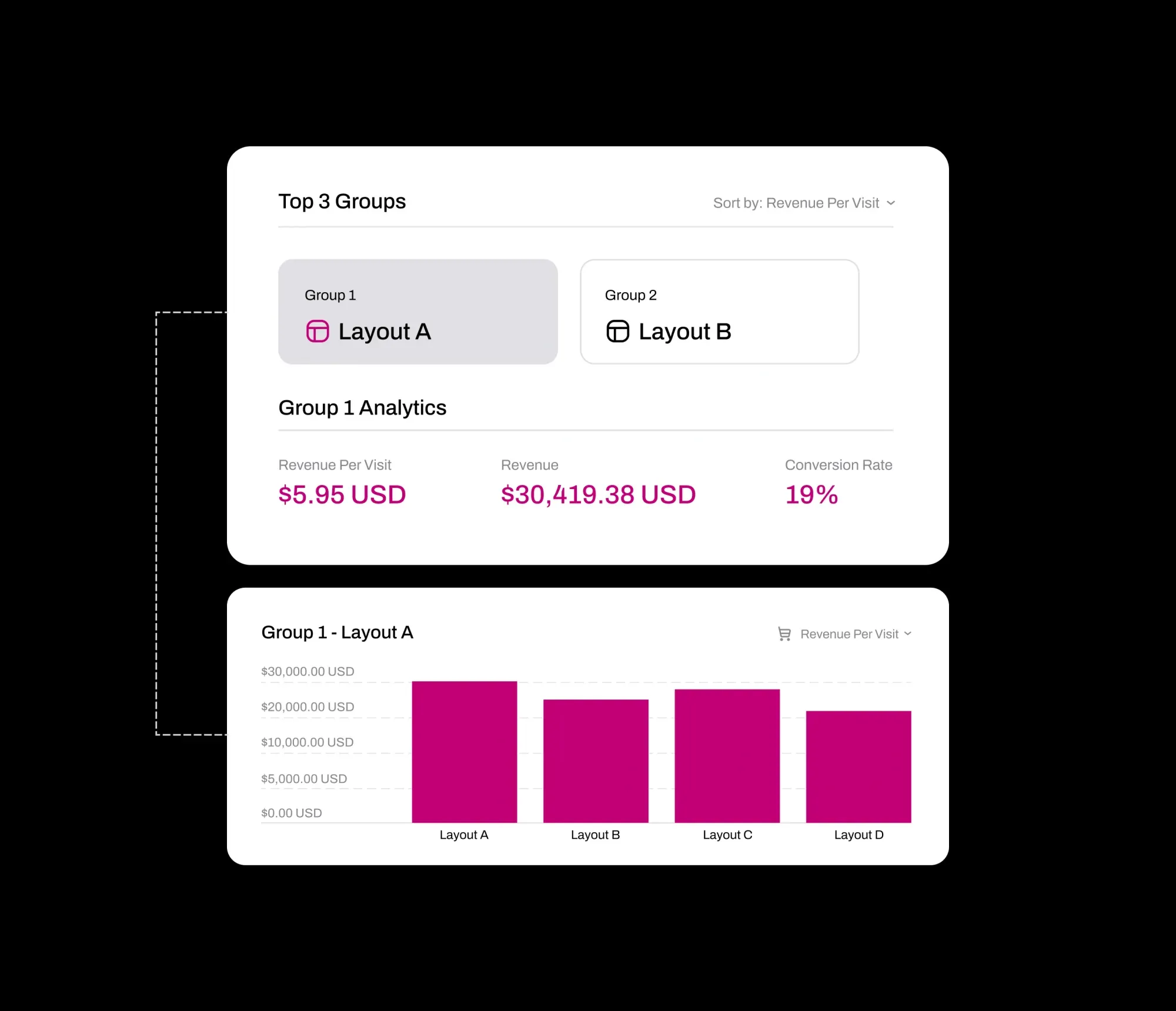
AOV increases, but profit does not
An offer can raise AOV while simultaneously hurting your margin through excessive discounts, low-margin products, or shipping costs.
The fix: Compare AOV with profit per order or visitor
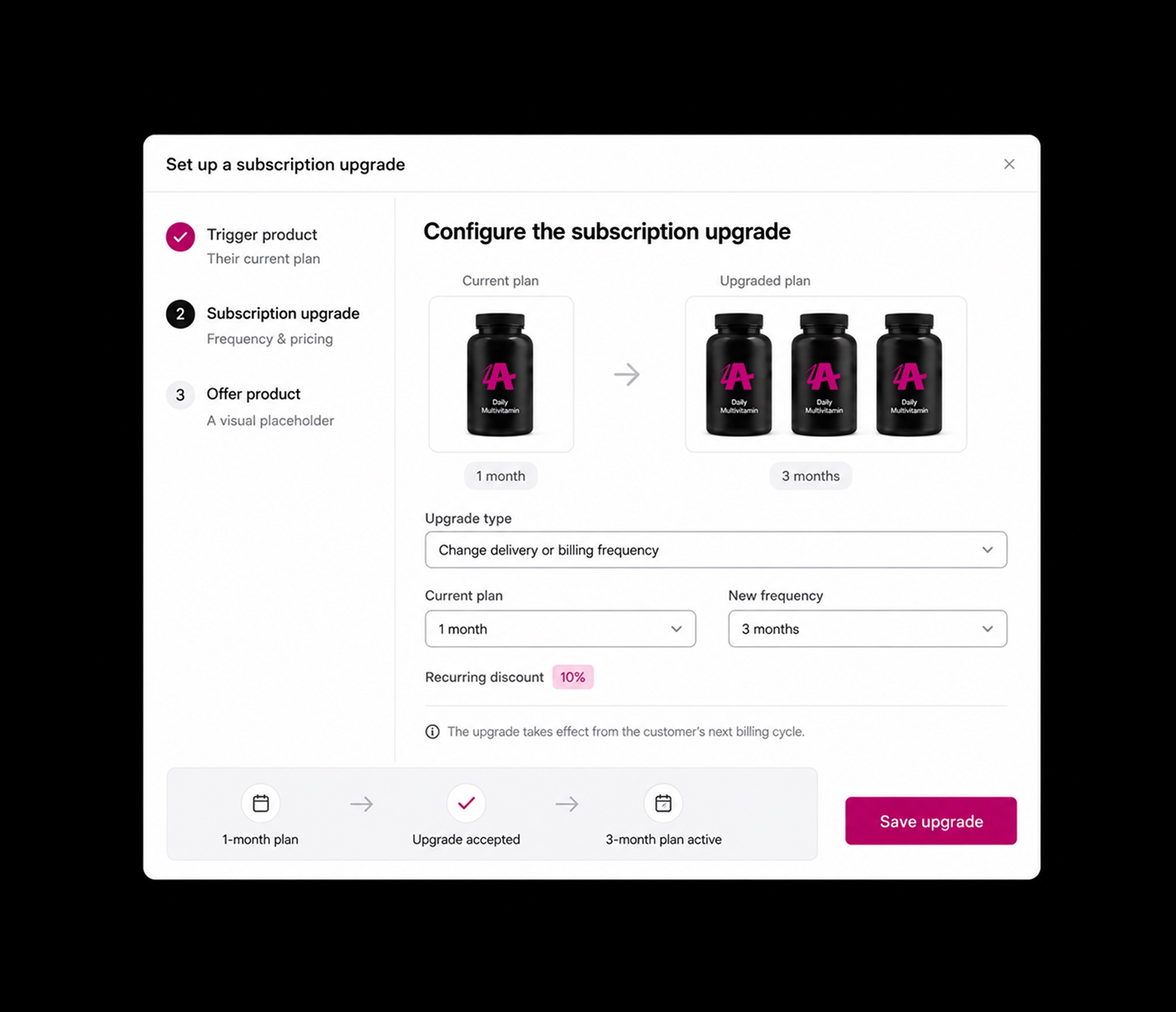
Combining AOV and profit per order or visitor can give you a realistic look at offer performance. Once you see the full picture, you may need to reduce the upsell discount, raise the upsell price, or replace the offered item with a higher-margin product.
You can also use subscriptions to test upgrade paths that increase customer value without relying on discounts. Aftersell's Subscriptions Upgrades feature lets you build targeted upgrade paths, offer longer plans, and provide discounts on upgrades to boost the incentive.
An offer that used to work has stopped working
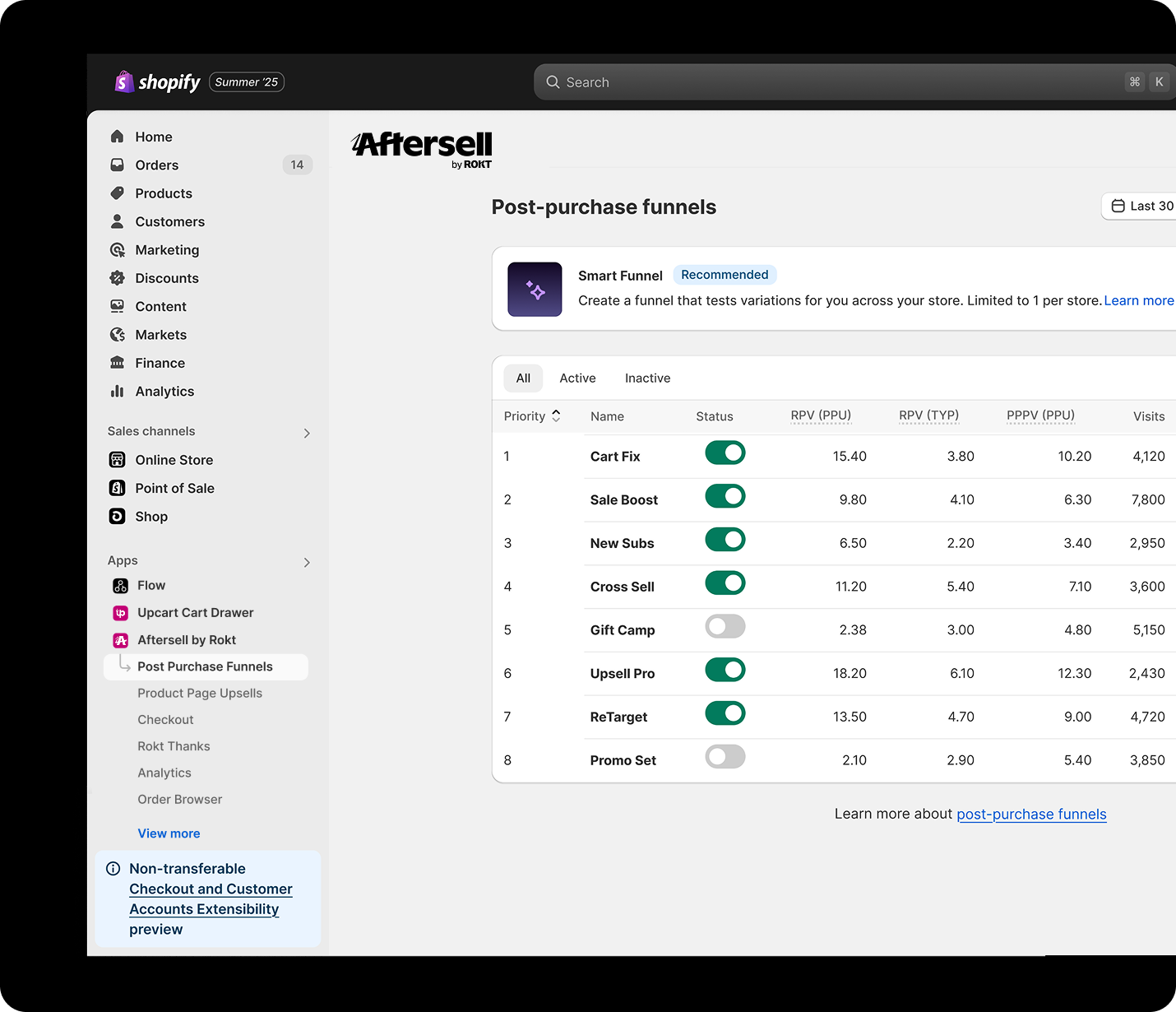
Musicians can tour forever on their greatest hits, but that logic doesn’t apply to automated upsell offers. An offer may be working well now, but that doesn’t mean it will keep performing that well forever. Product demand, seasonality, inventory, customer mix, and competing offers can all affect offer performance.
The fix: Set performance thresholds for offers
Give your offers an ultimatum: Set performance thresholds and use the data to determine when an offer should be paused or replaced. You can do this with Aftersell's AI Smart Funnels, which automatically adjust offers based on customer data and offer performance while letting you set limits and exclusions.
An offer performs well for one segment but poorly for another
One size does not always fit all. A product can be a strong recommendation for repeat customers and a poor recommendation for first-time buyers, or an offer can work for high-AOV carts but not low-AOV carts.
Segment-level performance analysis can often reveal the problem is not the offer itself, but who is seeing it.
The fix: Change who sees an offer instead of turning it off for everyone
Different offers can perform very differently across different customer segments. Personalization is key, and Aftersell’s post-purchase upsells make it easy to tailor your offers for different audiences. You can dynamically target customer segments using tags, purchase history, shipping methods, and other customer data.
Relevant offers aren't showing
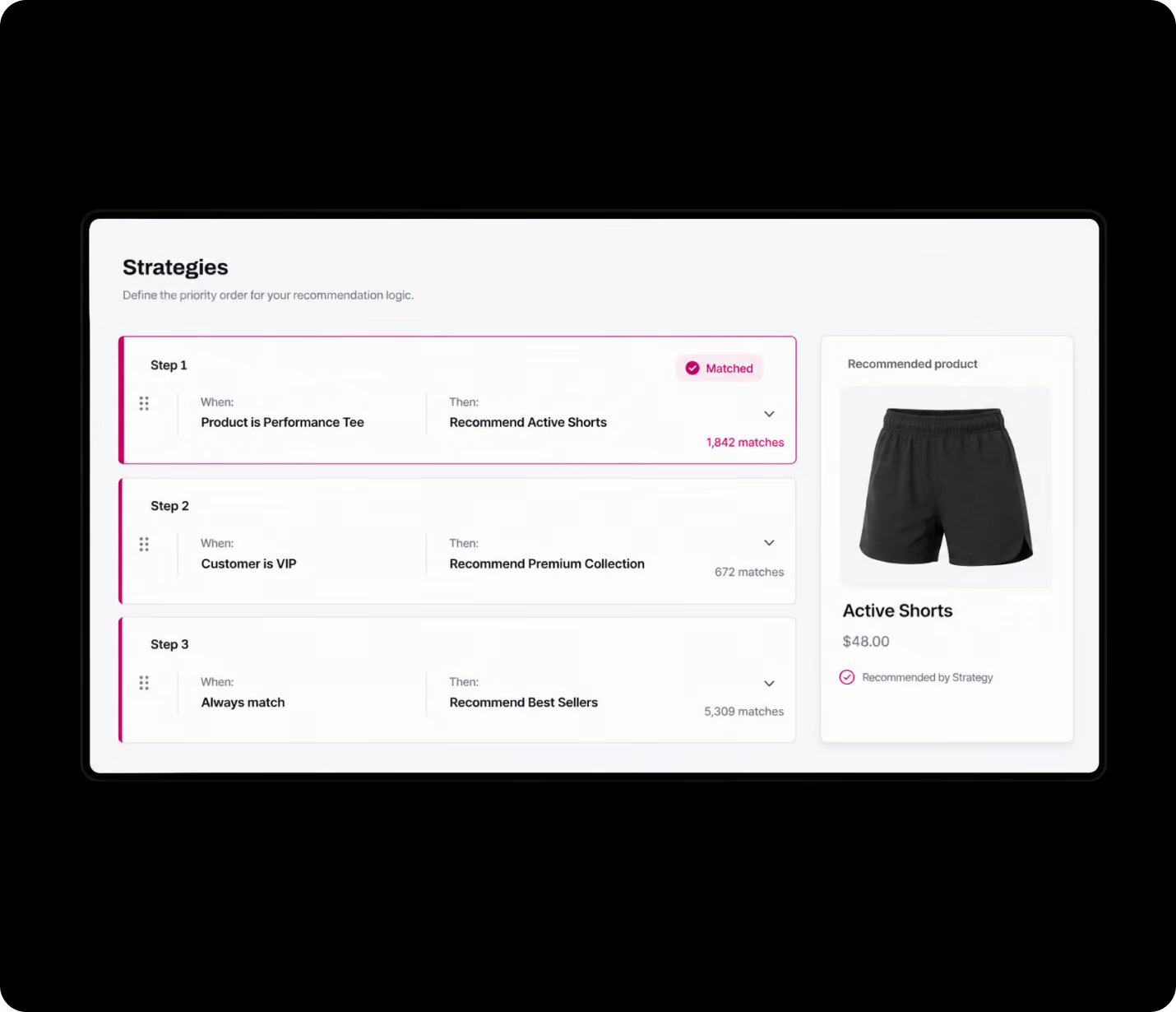
Sometimes offers can fail to appear. This could be because a product is unavailable, a shopper doesn’t meet the specific criteria, or another product rule takes precedence. Regardless of the cause, this creates an empty recommendation slot, which is a wasted opportunity to win a customer over with an offer.
The fix: Add fallback rules so the system can move to the next best recommendation
There’s no need to show off what an adrenaline junkie you are and skip the safety net. Adding fallback rules ensures there’s always an offer on display so you’re not stuck with an empty slot.
You can do this with Aftersell Strategies, which lets you define product and shopper conditions, set rule priorities and exclusions, and add catch-all fallbacks that can return another product when the top recommendation isn't eligible.
Automatically find the right offer for the right customer
Remember our four Ws? What should you offer, who should see it, where should it appear, and when should you stop showing it?
Every customer brings a different context to a purchase, and what may be the right fit for one may be completely wrong for another. A good Shopify upsell automation strategy answers those four questions to craft a more personalized experience that can automatically adjust as needs and behaviours change. The result is a stronger upsell and cross-sell experience that can drive real value on every order, not that giant catch-all net.
With Aftersell, you can give customers relevant, one-click offers, and use your customer and order data to help match each shopper with the right upsell or cross-sell.
If you’re ready to make more from every order (and let’s be honest, who isn’t?), try Aftersell on your Shopify store now, and build an upsell and cross-sell automation strategy that follows these best practices, answers the four Ws, and leaves you with offers that actually work.


