Anyone with a Costco membership knows what it’s like to go in for some toilet paper and come out with a 24-pack of ketchup, some muffins, and a new pair of jeans.
And maybe even a kayak.
No, this isn’t #sponsoredcontent. It’s just the perfect example of how upsells and checkout offers can work when there’s already intent to purchase something else.
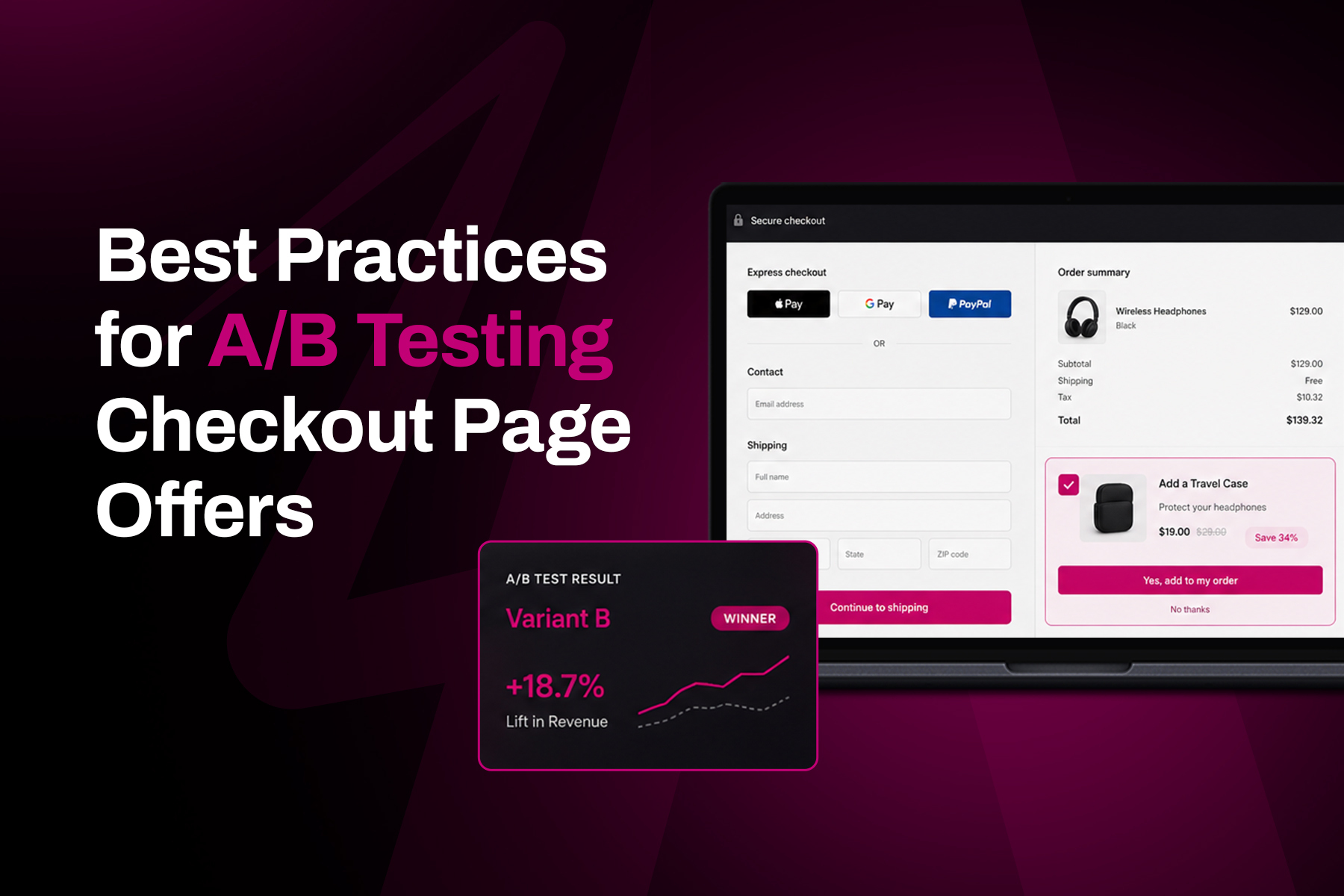
The challenge is that the “right” checkout offer is different for each shopper. In this article, we’ll walk through best practices for A/B testing checkout page offers to increase AOV.
For ecommerce businesses, this kind of conversion rate optimization, or CRO, is less about guesswork and more about using real customer behavior to boost conversions, improve conversion rates, and make informed decisions across the entire customer journey.
Because the difference between a 3% and 12% conversion rate often isn’t the offer itself. It’s how hard or easy the offer is to accept.
We’ll also show you how you can test checkout offers with powerful built-in A/B testing capabilities at Aftersell, allowing you to run thousands of test variations and identify the highest-converting offers.
Checkout Offer Testing vs Other A/B tests
Let’s start with the obvious: the checkout page is a high-intent page. Like a display full of 40-packs of gum by the self-checkouts, it’s a great opportunity to ride the wave of someone already committed to a purchase.
In traditional A/B testing, the focus is on increasing conversions. But customers are visiting these other pages much earlier in the funnel.
Unlike a homepage, landing page, or product page, customers at checkout are already ready to buy. They’ve usually shifted focus to completing their purchase and looking for more information on what happens next, whether that’s shipping information or loyalty information.
That also means the metrics you care about will change depending on where the test happens.
On landing pages and product pages, you might prioritize click-through rate, bounce rates, or call-to-action button engagement. On the checkout page, the bigger question is whether the offer improves the checkout process without increasing cart abandonment.
Brands should approach checkout page A/B testing completely differently. The checkout page isn’t where you need to sell customers on your brand or product—you should focus on increasing AOV.
Checkout offers need to prioritize speed, clarity, and relevance. For example:
- One-click upsells for impulse buys or a larger order at a discounted price
- Personalized or relevant offers based on either what’s in the customer’s cart or their purchase history
- Thank you page offers for an easy add-on after the sale
The best offers also respect the user experience. A high-impact offer should feel like a helpful addition to the online shopping experience, not a pop-up or interruption that slows down the checkout flow.
When it comes to measuring success, AOV should definitely be top of mind. However, there are a few other metrics you should be monitoring too:
- Upsell revenue per order - how much additional revenue did the upsell offer generate?
- Checkout completion rate - how many customers actually completed the checkout?
- Checkout abandonment rate - did your offer cause the customer to leave?
- Offer acceptance rate - what is the percentage of checkout page offers that are being accepted?
By tracking these, brands can identify which offers resonate with their customers and which ones are actually turning them away.
Foundation First: Building Strong Checkout Offers Before You Start Testing
Before you begin testing, you need a strong checkout foundation: a checkout experience that aligns with your brand and delivers relevant, valuable offers to customers.
That foundation includes basic functionality, too. Before running a split testing program, make sure your checkout page works cleanly across devices, especially on mobile, where users may be more sensitive to extra steps, slow-loading elements, or confusing pricing details.
Before getting too deep in the weeds and setting up any complex logic or segmentation, start with primary widgets that display to all customers. This ensures every checkout session can see your offers and provides you with a baseline to measure against in future tests.
There are several types of checkout widgets, each suited to different offer strategies:
- Single product upsells - best for focused, high-confidence product recommendations
- Multi-product upsells - ideal for large catalogs and personalized recommendations
- Checkmark upsells - primarily used for low-friction add-ons like shipping protection, gift wrapping, or inexpensive complementary products
No matter which you choose, the goal remains the same: provide a relevant offer that delivers actual value. Whether it’s a "can't miss” upsell or a complementary product recommendation, customers should feel enticed, not put off.
If you’re using Shopify, this is also where integrations matter. The easier it is to connect offer logic, product data, discount rules, and real-time analytics, the easier it becomes to optimize without slowing your team down.
Once your foundation is built, some trends in your data will start to emerge. That’s when A/B testing becomes truly valuable, and you can identify which offers are performing and which need improvement.
If you want more resources on checkout best practices, check out our best practices guide for checkout experiences.
The most effective checkout page offers you can A/B test
With your foundation in place and offers set up, you're ready to start A/B testing.
Of course, starting is often the hardest part. Without knowing how to effectively test checkout offers, it can feel pretty daunting. Luckily, we've done the hard part for you.
Here are some of the most effective checkout offer A/B tests you can run:
Testing product recommendation strategies
The golden rule written in the sacred e-commerce texts is that every checkout offer needs to revolve around a product or service to upsell.
It sounds simple, but it's surprisingly easy to miss the forest for the trees as you build out offers. At the end of the day, the product remains the biggest factor in whether a customer accepts an offer. Even if your checkout page is beautifully designed and your offer is perfectly timed, customers still need to want what's being recommended.
Some product recommendation offers you can A/B test in Aftersell include:
Specific products, collections, and AI recommendations:
- Specific products - Manually select individual products to upsell. This is ideal for seasonal promotions, complementary products, accessories, or carefully curated pairings.
- Collections - Select a collection and display up to 5 random products from it. Products already in the cart are automatically excluded to avoid duplication. Collections are great when you want variety within a curated set instead of manually managing individual products.
- AI recommendations - Let Aftersell automatically recommend products based on a customer’s cart contents. AI recommendations work best when you have a large catalog and want personalized recommendations without extensive manual curation.
Category pairings vs complementary products:
- Category pairings - If customers commonly purchase multiple variations of the same product (such as different flavours or scents), recommending related products can be an easy upsell opportunity.
- Complementary products - Testing complementary products that feel like a natural addition to a customer's cart can help offers move from pushy upsells to no-brainers.
Best sellers vs personalized:
- Best-sellers - Highlighting a rotating collection of your store-wide best-sellers without duplicating what’s already in your customers’ cart is a great way to offer customers products that are already proven to sell.
- Personalized recommendations - Use the customer’s site activity, cart contents, or purchase history to personalize product recommendations unique to each customer.
If you’re unsure which direction to take, start with your target audience and their buying patterns. Heatmaps, purchase history, and checkout behavior can all help reveal where shoppers hesitate, which products they compare, and which recommendations are most likely to feel useful instead of random.
Testing discount structures
Everyone loves a discount, but discounts don’t always increase profitability. The trick is to find the smallest incentive needed to encourage offer acceptance and provide genuine value without unnecessarily reducing margins.
Here are some ways you can A/B test discount structures in Aftersell:
- Percentage vs fixed dollar - How a discount is presented can significantly impact customer behaviour. Test to discover whether a percentage or fixed dollar format feels more compelling to your audience and entices them enough to accept the offer.
- Discount vs no discount - Many Shopify brands believe checkout page offers always need a discount for customers to take action – but that’s not necessarily true. In reality, a relevant and compelling offer may perform just as well without one.
- Threshold-based incentives - Encourage customers to spend more to unlock an offer, free product, or free shipping. Test these against standard static offers to see which has the bigger impact on AOV.
Testing checkout offer placements
Believe it or not, placement matters. Something as simple as moving an offer to a different part of the page can have a sizable impact. Offer layout and design also play a key role in attracting and keeping a customer's attention throughout the purchase process.
In fact, checkout placement can change performance dramatically even when the product, pricing, and audience stay the same. In Aftersell checkout data, offers placed before the “Complete Order” button saw a 6.96% offer acceptance CVR and 3.40% actual purchase CVR, making it the strongest placement for fast, low-friction impulse items.
By comparison, generic checkout blocks were more common and produced a lower offer acceptance CVR of 3.06%, but their $43.58 AOV made them a stronger fit for higher-ticket upsells where customers may need a moment to consider the offer.
Once you’ve ensured your checkout process is airtight, you can start building on that foundation with different offer placements.
Some options worth testing include:
Single product vs. multi-product layouts
- Single product layouts - Useful when you want to keep things simple, remove the barrier of choice, and ensure customers don’t have to think twice.
- Multi-product layouts - Offer customers more choice, which can be a good thing for increasing engagement and the chances of them seeing a product that resonates. However, these can also increase decision fatigue.
Add to cart button vs checkbox upsell
- Add to cart button - Make the purchase feel more deliberate and provide greater product visibility. They work especially well when products have multiple options such as colours, flavours, or sizes but can also add friction to the checkout process.
- Checkbox upsell - can be effective for low-price add-ons and complementary products. They’re fast, feel frictionless, and easy to accept but can become more challenging if products have multiple options or choices.
The key is matching the placement to the decision you want the customer to make. If you want the highest click-through rate or fastest “yes,” test the offer near the final call-to-action. If you want more revenue per impression, a more considered placement inside the checkout flow may perform better.
If you’re on the hunt for even more upselling strategies, our guide on finding better upsell opportunities is a great place to start.
How to structure a clean A/B test for checkout page offers
An A/B test is only as good as its results. Without proper controls in place, you’re not testing offers – you’re just randomly showing them to customers.
So how do you keep your data clean? We recommend testing one element at a time with a 50/50 split. When multiple variables change at once, it becomes nearly impossible to determine which change actually influenced the result.
By isolating one variable per test, you can get clear, actionable insights. Any more than that, and you’ll muddy the waters.
For example:
- Good: Test 10% discount vs. 20% discount (one variable changed)
- Not good: Test 10% discount + Product A vs. 20% discount + Product B (two variables changed at once)
Another important consideration is avoiding seasonality spikes. If you test during Black Friday, Cyber Monday, or other holiday periods, you won't get a true representation of customer behaviour and purchasing patterns and you might draw the wrong insights.
You should also include a true control group. Without one, it's much harder to determine whether your changes actually improved performance or if the results would have occurred naturally.
A simple example of this can be two checkout versions that a test group will see.
- Checkout Version A: Checkout offer is served to this group.
- Checkout Version B: No checkout offer is displayed.
Clean, simple, easy to measure.
Timing matters too. A test needs enough traffic to produce meaningful results. Results will look very different across 50 sessions, 100 sessions, and 1,000 sessions.
Finally, consider segmentation. Not all customers behave the same way, so test different groups based on factors like purchase history, cart value, or customer behaviour.
With Aftersell, you can view powerful group-level analytics that highlight which segments performed best and which A/B test had the biggest impact on your key metrics.
Common mistakes when A/B testing offers
Look – we all make mistakes. But when it comes to A/B testing, you don’t have to. Your pals here at Aftersell have highlighted four of the most common mistakes brands make when testing checkout offers. Avoid these, and it’ll be smooth sailing for both you and your customers.
Mistake #1: Picking a winner too early
Probably the most common A/B testing mistake is declaring a winner before you've collected enough data.
As tempting as it is to see an offer performing well out of the gate and crown it the champion, reliable conclusions require a meaningful sample size. A few early wins don't necessarily indicate long-term success.
Once you’re confident there’s a clear winner between your two options, deactivate the losing option and bask in the glory of your excellent decision-making.
Mistake #2: Assuming clicks mean success
Anyone who has been around PPC long enough knows that clicks are an all-important measurement. And they are! But it’s a little different for checkout offers.
For checkout offers, clicks aren’t the gold standard—AOV is. Optimize for revenue first, and use the actual revenue you’re seeing as your primary measure of success.
A CTA button may get attention, but if it does not improve average order value, checkout completion, or overall revenue per order, it may not be the winning version.
Mistake #3: Showing irrelevant offers
More isn’t always better.
Depending on your strategy, it can sometimes make sense to show multiple products–especially when highlighting best-sellers or collections—but not always. The key is to ensure every offer you’re showing is rooted in strategy.
Ask yourself a simple question: can you explain why this offer makes sense for this customer? If not, you should probably go back to the drawing board.
The best checkout offers are the ones that feel helpful, relevant, and organically connected to what’s in the customer’s cart.
Mistake #4: Testing too many offers
A/B testing is fun, especially when you start seeing results. But it’s important to resist the urge to go offer-crazy and test every idea that pops into your head.
Running too many experiments simultaneously can skew results and complicate your insights.
When in doubt, prioritize high-impact tests that connect directly to your business goal, whether that’s higher conversion rates, increased conversion rates on upsells, or a healthier checkout flow.
Mistake #5: Focusing too much on one device
While it’s always worth checking your checkout experience across devices, our data shows that mobile vs. desktop has almost no structural impact on checkout offer conversion.
Across 17M impressions, mobile accounted for 80% of volume with a 0.62% CVR and $21 accepted offer value, while desktop accounted for 20% of volume with a 0.75% CVR and $23 accepted offer value.
In some weeks mobile leads; in others desktop does. The takeaway: don’t overbuild device-specific offer strategies. Focus first on offer relevance, placement, and how easy the offer is to accept.
Start your A/B testing journey with Aftersell
So is A/B testing worth the time and effort? Ask GOAT Foods, which made the switch to Aftersell to simplify and scale its upsell strategy. They ran A/B tests on everything from products to offers and saw a 25-50% increase in revenue per order and upsells included on 30-40% of orders.
At the end of the day, your goal should simply be to show customers the right offer at the right time. Your job is to figure out what turns a “maybe” into a “definitely”.
If you build a strong foundation, test the right offers, and avoid common mistakes, you’ll be well on your way to increasing your AOV.
And if you want the right platform for the job, look no further than Aftersell. Book a demo today and gain real insight into what your customers actually respond to.
Recommended Reading
.jpg)