What have you done lately to help grow your business?
No, really—that’s not just a rhetorical question. Because if cross-selling strategies aren’t already at the top of your ecommerce growth checklist, they should be.
Let’s talk about why.
At a high level, cross-selling helps you increase revenue by making better use of traffic you already have. Instead of relying solely on customer acquisition, you’re creating more value from existing customers—which is almost always more cost-effective in the long run.
A strong cross-selling strategy boosts average order value, customer lifetime value, and ultimately your bottom line—without increasing ad spend.
How does cross-selling do this? By presenting cross-selling opportunities to shoppers who are already engaged, already trusting your brand, and already pulling out their credit card.
Here’s the good news: building a successful cross-selling strategy is simpler than most retailers think.
It comes down to understanding customer needs, analyzing customer data, and recommending the right products at the right time across the customer journey.
Read on for our top five tips for building a strategy that actually converts.
Cross-selling vs. upselling
Cross-selling is when you recommend complementary products or related products that enhance the shopper’s original purchase.
Are they looking at shampoo? Why not recommend conditioner and body wash as additional products? Shopping for a scarf? Suggest a matching hat and gloves. These are classic examples of cross-selling that feel natural—not pushy.
Upselling, on the other hand, focuses on encouraging customers to purchase a higher-end version of the initial purchase—often at a higher price point.
Both approaches are effective sales techniques, but they serve different roles within your broader sales strategy. When done well, both can improve conversion rates, strengthen customer relationships, and increase customer satisfaction.
Still a little confused? This handy blog lays out more key differences for you.
Before you start—keys to a good cross-selling strategy
A good cross-selling strategy starts with identifying what products to cross-sell together, based on your data. Then you determine when products should be offered to customers.
Products and pricing
A strong strategy starts with pairing relevant products that naturally go together. Think complementary items, not random add-ons.
The best cross-sell offers are easy to say yes to. They’re typically priced lower than the original purchase and add clear value without friction.
When shoppers see immediate benefit—without feeling pressured—it builds trust and keeps the experience positive.
Data
Effective cross-selling is rooted in data. Review purchase history, past purchases, browsing behavior, and what your customer base frequently buys together.
Use this data to power smarter product recommendations, tailored to both new customers and loyal customers.
Personalization isn’t optional anymore—it’s table stakes for a strong customer experience.
71% of consumers expected companies to deliver personalized interactions. 76% of consumers got frustrated when it didn’t happen.
Time and place
As famous physicist Albert Einstein once said, "Timing is everything.”
Okay, maybe Einstein didn’t actually say that, but the message still stands. Knowing when to offer your cross-sell product is just as important as the cross-sell product.
You should implement your cross-sell strategy throughout the customer journey. It should also use complementary products based on what’s already in a customer’s cart or what they’re browsing for.
Offer items at points where the customer is most likely to engage. This could be:
- On the product page
- At the checkout
- At a post-purchase touchpoint, like a confirmation or thank-you page
Test out which point of the customer journey works best for your cross-sell strategy.
Top 5 tips to build a better cross-selling strategy
When cross-selling is aligned with real pain points, supported by smart CRM insights, and delivered at the right moment, it becomes one of the most reliable ways to increase sales and grow sustainably.
Let’s talk about how to do that.
1. Analyze your ecommerce data
The strongest cross-sells feel natural and obvious to customers shopping on your site. You wouldn’t suggest someone buying a new pair of boots to also buy bananas—not that there’s anything wrong with bananas.
But instead, think candles and lighters, or shoes and socks. To deliver a strong cross-sell strategy, you need to understand your products, your customers and their purchase patterns.
Lucky for you, there’s an easy way to do that with Aftersell. The Rokt Brain uses real-time AI to match each shopper with the offer they’re most likely to act on.
You can also analyze purchase patterns from new and returning customers. Aftersell delivers test variations to instantly find the highest-converting offers. We can even help identify product pairings based on real order data.
Last tip: segment your new vs. returning customers to make your cross-sell offers more personalized to each group.
2. Bundle your products
Product bundling can help customers associate products that naturally go well together.
Ecommerce brands often call these out on product pages as “Customers also purchased” or “Complete the set.”
If the recommended product costs less or is discounted, shoppers feel like they’re getting a great deal on an extra item.
A great cross-sell strategy shouldn’t add any friction to the customer journey when introducing an additional product. These types of targeted offers make adding that extra item feel like a no-brainer for customers.
65% of customers see targeted promotions as a top reason to make a purchase.
Case study
When checkout infrastructure changes forced a strategy reassessment, accessory brand Ridge found a solution—with the help of Aftersell.
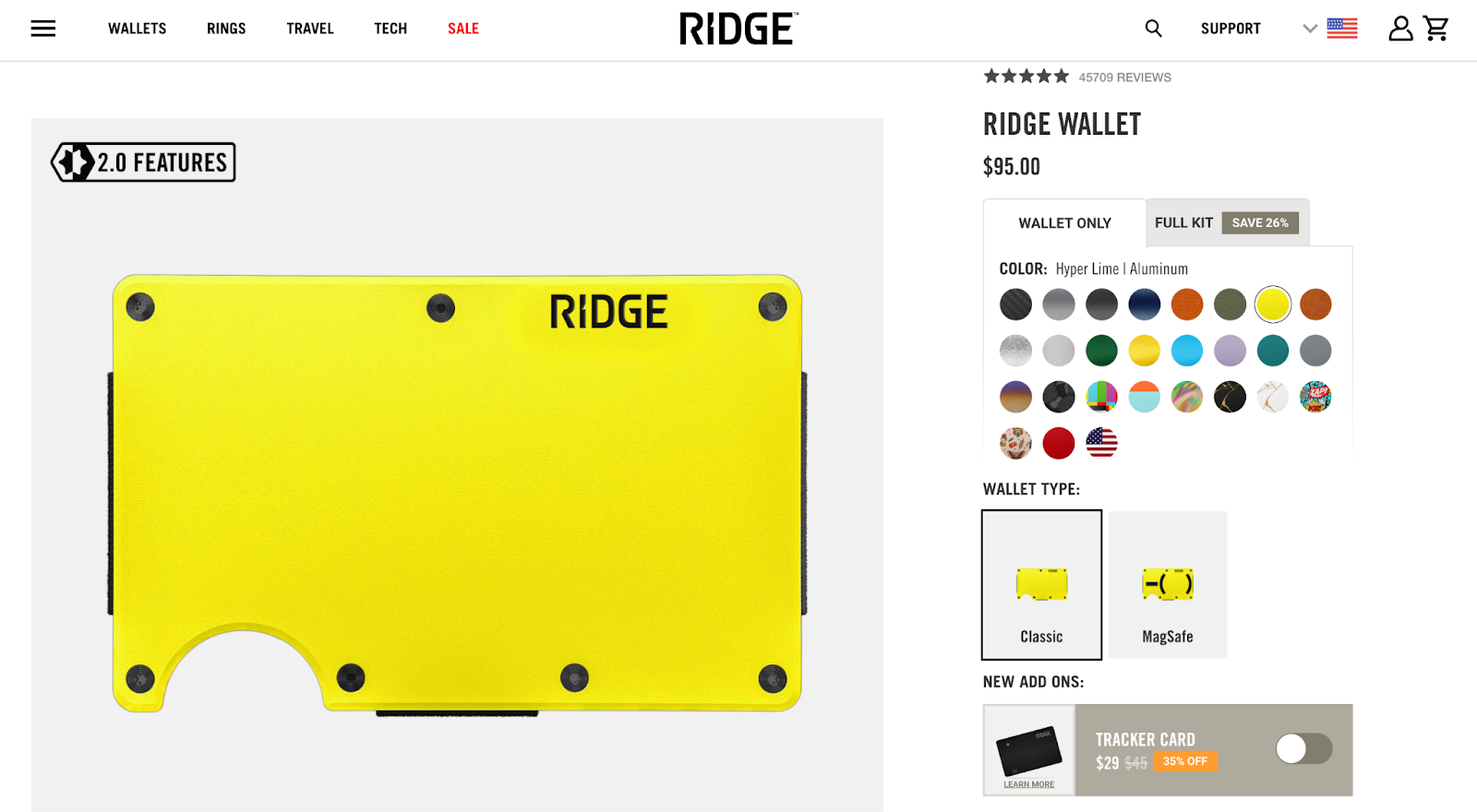
They simplified cross-selling by recommending an “add-on” tracker card that pairs well with their Ridge Wallet.
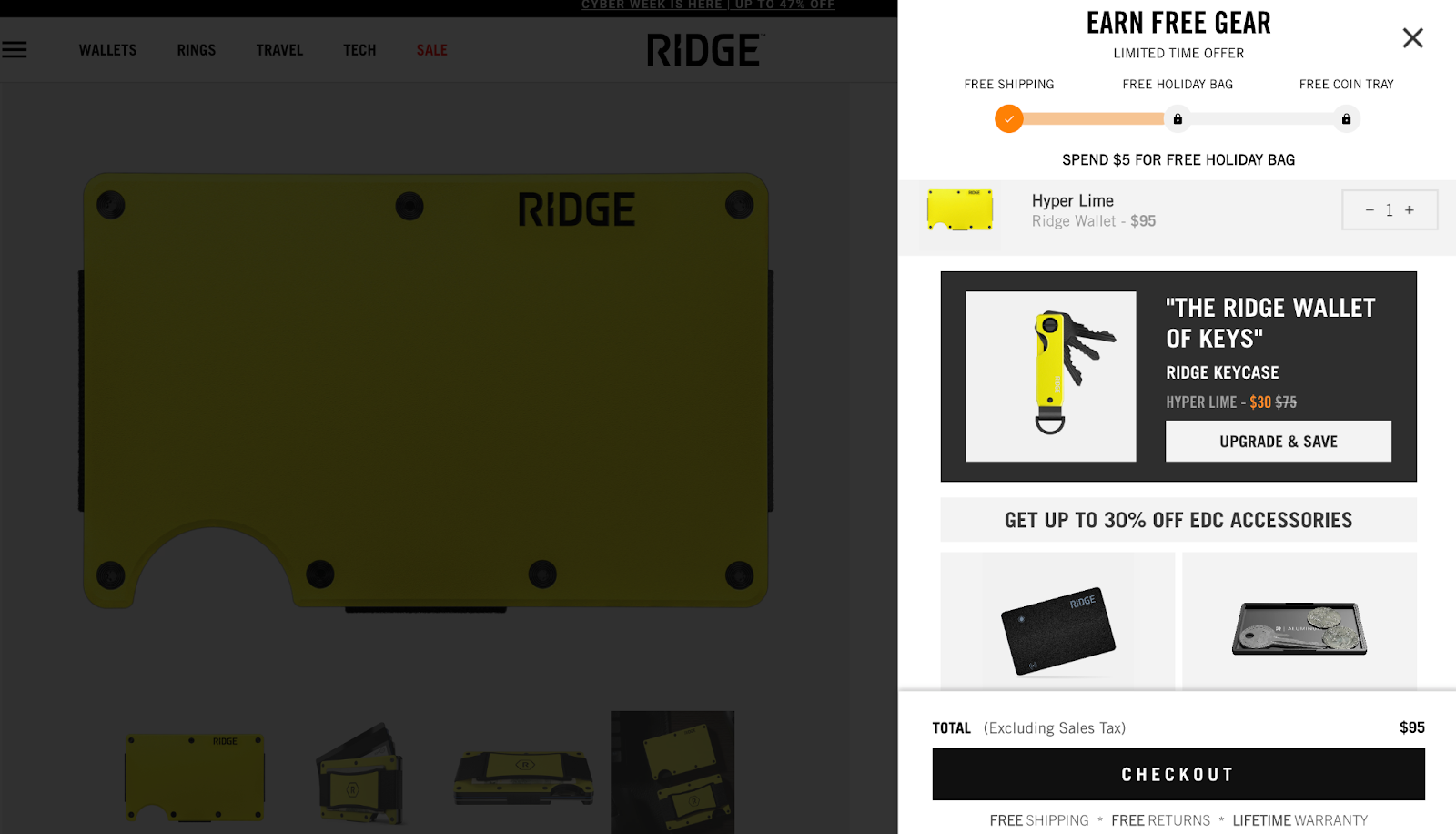
This cross-sell works perfectly because it complements the Ridge Wallet at a much lower price point. Customers can simply add the additional product to their cart either on the product page or at checkout.
Results
Aftersell empowered Ridge to:
- High-conversion upsells synced across five stores
- Reduced engineering workload with Aftersell-managed funnel duplication
- Better customer experience through affinity-based offers
- Built a post-purchase testing ground for exclusive offers
3. Personalize cross-sell recommendations
Implementing a personalized customer experience can drive conversion and retention.
Once you analyze your ecommerce data and determine what products to recommend together, you can create personalized cross-sell strategies. You can base these strategies on what a customer has in their cart and what they’ve bought in the past.
Make sure that your product recommendations fit into the customer’s context so they convert at a higher rate.
Remember to always cross-sell items that are relevant (not boots and bananas!). Otherwise, customers will ignore the recommendation.
Highly personalized shopping experiences made customers110% more likely to add items and 40% more likely to spend more than planned.
Example: Good Protein
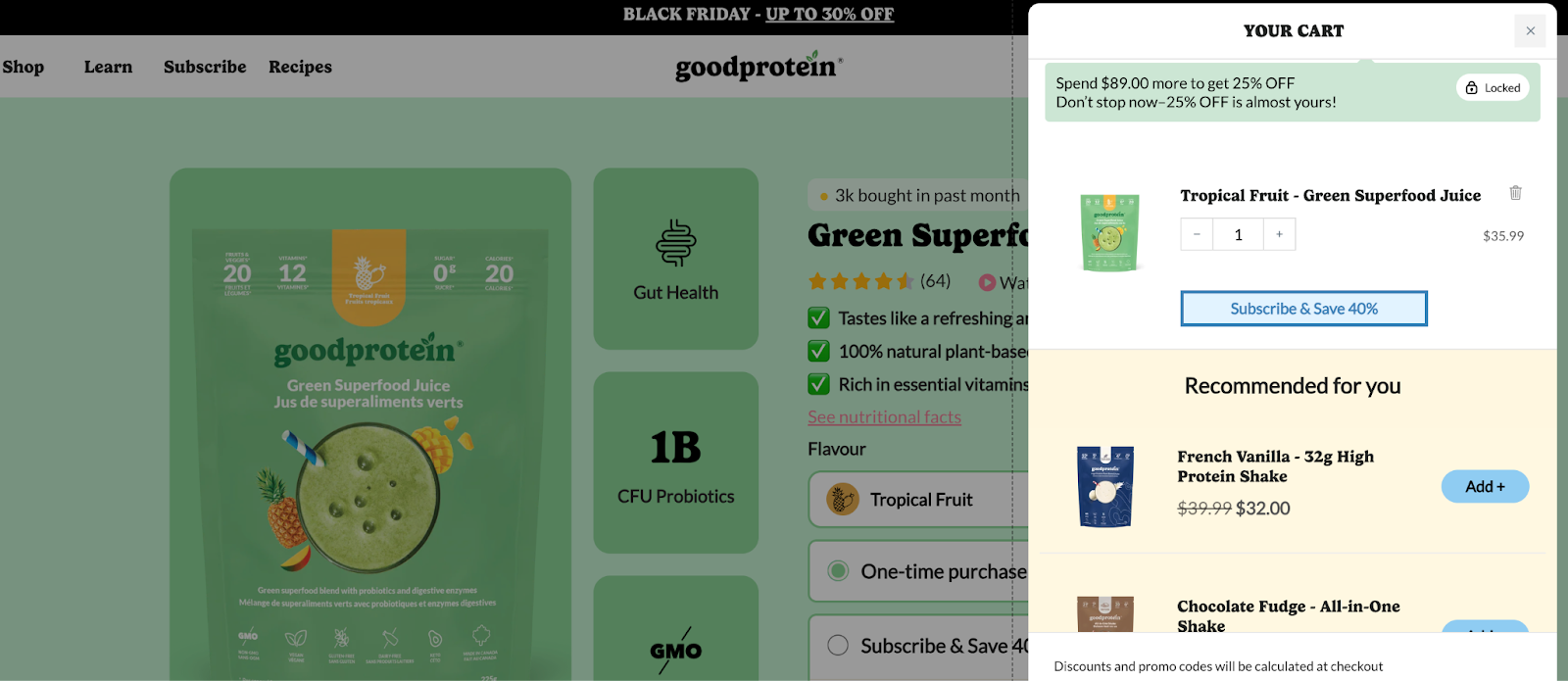
Wellness brand Good Protein was looking for a way to improve product discovery and boost AOV without overwhelming the customer. Their solution—with Aftersell's help—was to offer personalized discounted upsells and a rewards bar to incentivize customers, naturally flowing into their checkout.
For example, Good Protein will recommend that someone buying one of their green juice blends should add protein to their cart for a more complete wellness routine.
Results
- 4.97% of total revenue attributed to Aftersell and related tools
- $92k additional monthly revenue generated
- 35% increase in conversion rate for SMS campaigns
4. Know where to place cross-sell offers
Knowing when to offer your cross-sell product is just as important as the actual product. The key is not to interrupt the customer journey and experience on your site.
Offer items where the customer is most likely to engage, like on the product page, in the cart, at checkout or at a post-purchase touchpoint (like a confirmation or thank-you page).
Example: Carnivore Snax
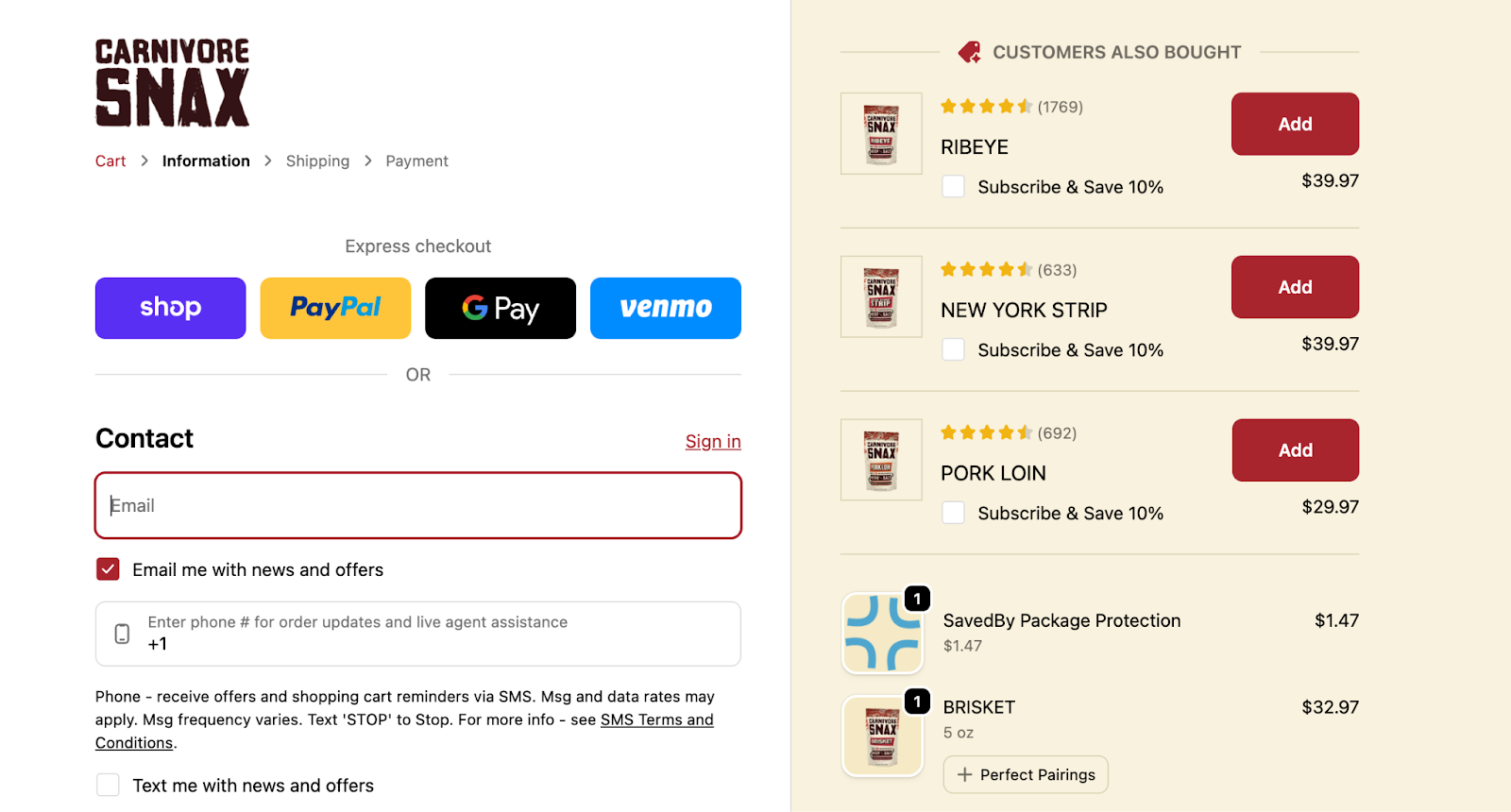
Carnivore Snax had built up a loyal following with their high-protein, 2-ingredient meat snacks. But they weren’t earning anything extra from the payments page.
The solution? With the help of Aftersell, they displayed targeted offers at the checkout that customers can add with one click. They’re marked with their customer ratings, and make it simple for shoppers to add before clicking to the next step.
Results
- $4,500+ incremental revenue to date
- $0.15–$0.16 average profit per transaction (RPT)
- No conversion loss
5. Post-purchase touchpoint
It’s estimated that post-purchase confirmation emails receive the highest open rate of any email, at 65%.
These confirmation emails are not only an important part of the workflow, but can help give customers peace of mind that their order is on its way. Be sure to track performance of these emails across important metrics like revenue, transactions and AOV.
Case study
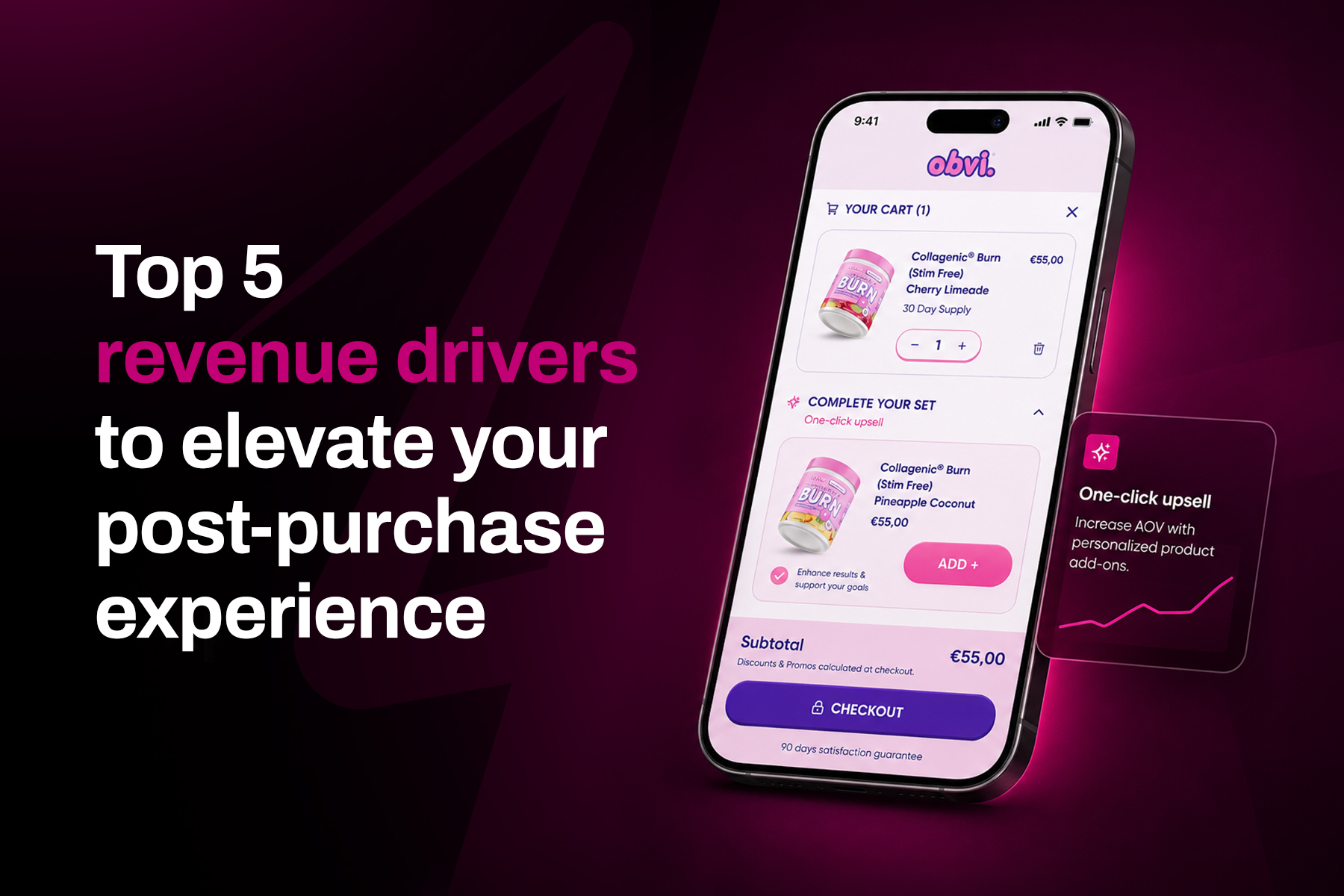
Obvi is a health and wellness brand that was having trouble standing out in a crowded supplement market. With the help of Aftersell, Obvi gained the tools to overcome this challenge. Obvi implemented 1-click post-purchase funnels and Rokt Thanks. This gave Obvi more wiggle room for customer acquisition and some fantastic results.
Results
- $10K profit/month
- $7.50 increase in AOV with post purchase upsells
- $0.50 profit per order with Rokt Thanks
It’s simple: cross-selling is proven and profitable
Cross-selling is an ecommerce essential. It scales growth and increases revenue through an increase in AOV and CLV—without having to spend money on acquisition.
Get a tailored Aftersell walkthrough with real examples and proven tactics to boost AOV, retention and thank-you page revenue.
Recommended Reading
.jpg)