Revenue is the fuel that drives every ecommerce brand. But lately, it feels like vehicles are stalling, and many brands are running on empty.
Rising consumer goods costs, tariffs, and sky-high customer acquisition expenses are shifting the state of the economy and ecommerce as we know it.
It’s more important than ever for brands to implement pricing strategy decisions that support revenue growth, protect profit margins, and improve cash flow — without relying on constant price increase tactics that can hurt customer loyalty.
For any business owner, the challenge isn’t just to increase sales, but to grow business revenue sustainably by meeting customer needs and improving the customer experience across every touchpoint.
So how do you keep up?
No matter how premium your fuel is, the rest of your vehicle needs to be maintained. Every part of your ecommerce site needs to be in-sync: product pages, checkout, upsell, subscriptions, and post-purchase flows.
These elements should work together to support revenue generation, improve customer satisfaction, and unlock new revenue streams without adding pressure to your sales team.
Long story short: driving revenue is still possible. You just need to approach it differently.
Here’s how:
Increasing revenue in ecommerce: a multi-layered process
Acquiring new customers is becoming more expensive than ever – the average cost to acquire a new customer in 2013 was $9 and increased to $29 in 2022 – a 222% increase.
For small business owners, startups, and growing retailers, this makes relying solely on marketing campaigns or paid acquisition a risky revenue strategy.
The key to zero-cost revenue growth is focusing on current customers and existing customers, not just promotion.
Customer-first revenue strategies put your customer base at the center of every decision — increasing customer value, improving customer retention, and turning loyal customers into repeat buyers through referrals and stronger customer loyalty.
If you want to scale without increasing spend, it all starts with optimizing the customer journey.
Unfortunately, there’s no single switch to flip. Increasing revenue is a multi-layered effort that spans digital marketing, email marketing, social media, checkout, and post-purchase flows.
But when these systems work together, brands can drive revenue, protect profit, and open up new revenue streams — all without chasing potential customers at higher acquisition costs.
5 ways to increase revenue in ecommerce
Here are some tried-and-tested sales strategies to get you started.
Optimize your product pages
Presentation is important, and your product pages are your showroom. They have the daunting task of juggling two priorities at once: highlighting what you have to offer while providing a smooth shopping experience.
It only takes one hiccup for someone to leave – and with cart abandonment rates hitting 70.22%, this problem isn’t going away anytime soon.
There are too many variables in place to ever eliminate cart abandonment, but you can take steps to mitigate them. Optimizing product pages is one of the most effective ways to do this.
Here’s how to get started:
- Show your value by setting up a clear value proposition for each product.
- Treat every product page as a landing page and deliver all key information a prospective customer needs to make a purchase decision.
- Optimize visual product page components through clear copy and high-quality images.
- Improve your UX by adding social proof, UGC, trust signals, shipping and delivery information, and product recommendations (i.e. “customers also bought” or “complete the look”).
For some shoppers, a product page is their first impression of your brand. If everything goes right, they'll be their last impression before checking out.
Improve AOV with upsell and cross-sell strategies
We know this sounds kind of obvious – increasing AOV will increase revenue. But there’s more to it.
When upsells and cross-sells are done thoughtfully, they don’t feel pushy and actually feel helpful. Customers see the value and often end up buying more.
It doesn’t have to be huge either – even small AOV lifts are still driving net new revenue at no extra cost. Our data shows that simple cart tweaks have generated almost $93,000 in extra revenue for brands, and when we say simple, we mean simple: even something as straightforward as recommending a higher quantity to save over time is surprisingly effective.
Cozy Earth has gotten real cozy with the concept of upselling and cross-selling.
They’re doing it directly on their product pages and again at checkout to encourage customers to increase their cart size. It works because it’s not just noise – each product recommendation is relevant and complements what the customer is shopping for.
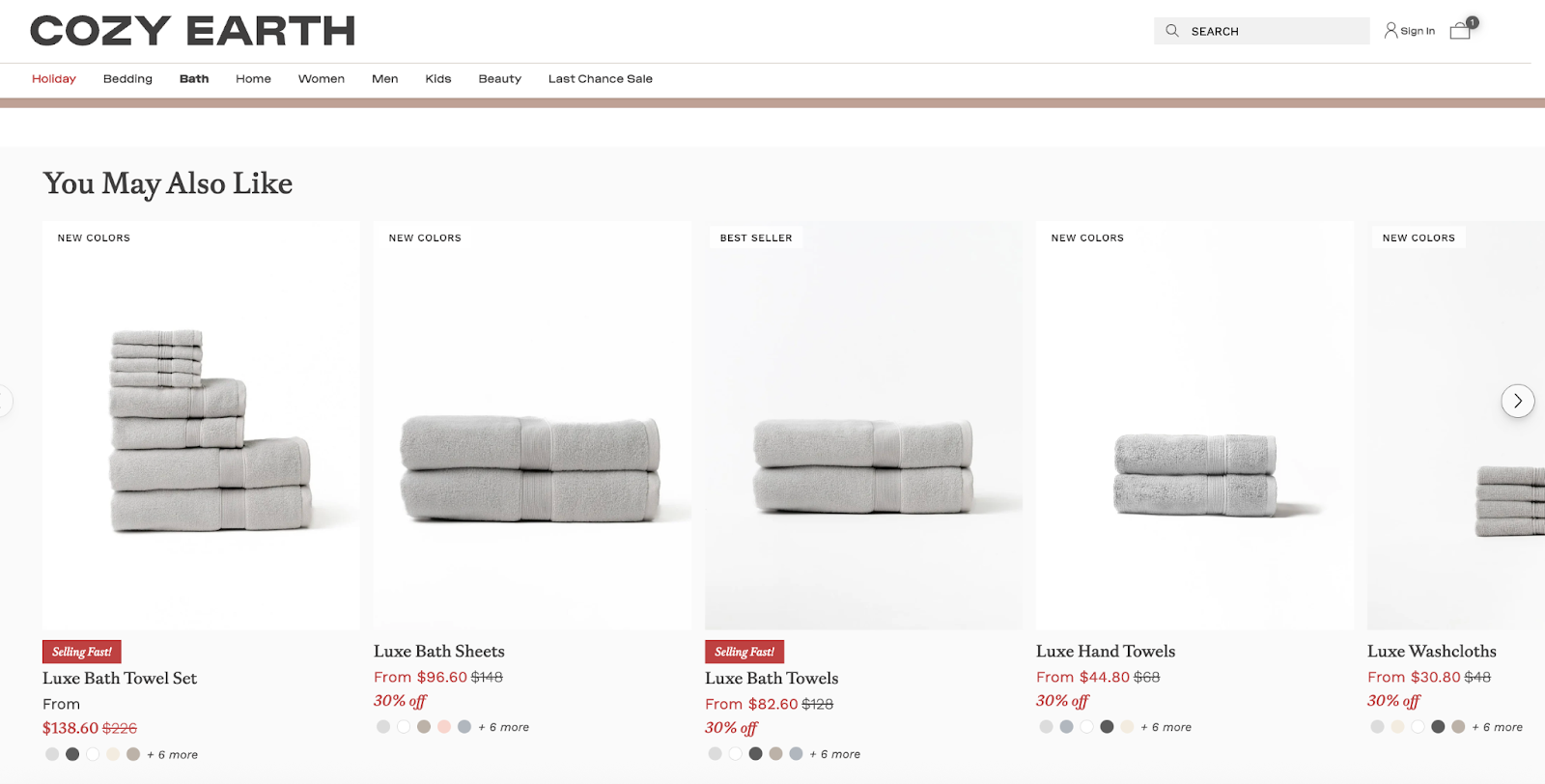
Cozy Earth’s placement strategy works for most brands: implement upsells and cross-sells in engaging areas such as the product page, cart, at checkout, and post-purchase confirmation (thank-you) pages.
Here at Aftersell, we recommend a combination of add-ons, recommendations, and upsells across the site, which can drive a 2x higher RPV versus a single upsell.
But before you get all upsell-crazy, remember: upsells and cross-sells only work when they’re relevant and show clear value.
A strong strategy uses ecommerce data to recommend products that complement what’s already in a customer’s cart. The key is to make it simple for customers – not overwhelm them. Relevance beats volume every time.
Focus on strategic recommendations over high-revenue items, even the smallest AOV lift is still net new revenue you didn’t pay to acquire.
Introduce subscriptions
Between streaming services, phone bills, cloud storage, and more, our lives are filled with subscriptions. It’s estimated that by 2028, online subscriptions will hit a staggering $2.3 trillion. That’s a lot of zeroes.
The convenience provided by subscriptions is unparalleled. As life gets busier for consumers and free time becomes an increasingly hot commodity, more brands are subscribing to the idea of subscriptions. A lot more:
Shopify discovered a 33% increase in the number of Shopify stores that offered subscriptions in the first 6 months of 2025 compared to the same timeframe in 2024.
We know “subscriptions” is a broad concept, and it’s not a one-size-fits-all approach. There are several commonly used subscription models:
- Subscribe and save is the most common, especially for CPG brands. This means subscribing saves the customer money versus a one-time purchase.
- Curated boxes and discovery subscriptions that surprise subscribers and encourage product exploration are becoming more common – especially with Gen Z and millennials. In fact, 80% of them now prefer this model.
- Membership and VIP subscriptions are another popular option. They’re great for brands that deliver ongoing value in exchange for an upfront, monthly, or yearly fee.
Beverage brand Brez has quenched its customers’ thirst for savings with a subscribe-and-save model that offers a 20% discount compared to a one-time purchase. That’s about $1 saved per can for the members and provides Brez with some extra revenue hydration.
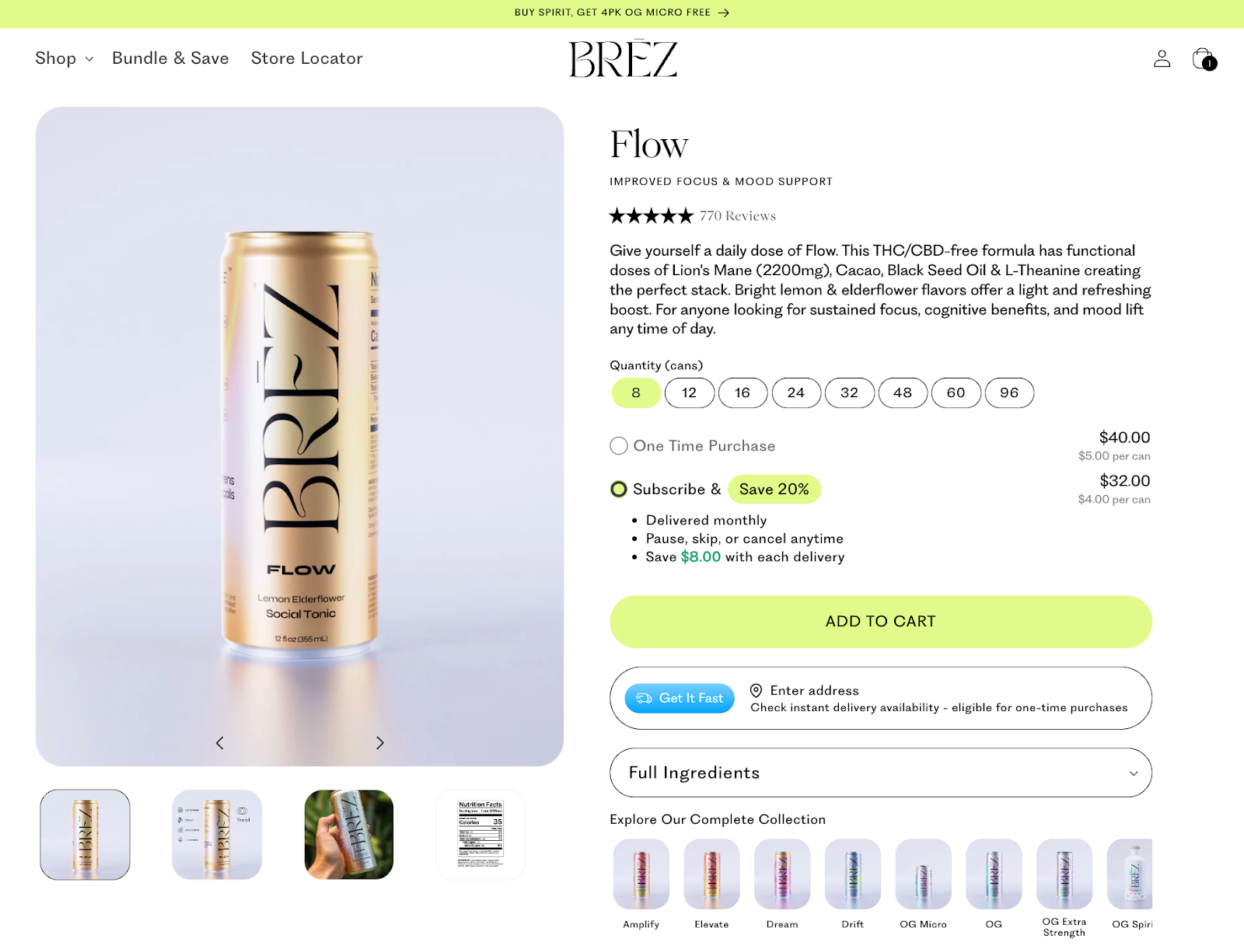
Whatever model works best for your brand, subscriptions excel at incentivizing customers to think long-term. Whether it’s saving money, scheduled replenishments, discovering new products, or receiving exclusive member benefits, subscriptions can make life easier for your customers and provide you with predictable, recurring revenue.
Checkout optimization
Your checkout process is the final turn for your customers before they cross the finish line – you’ve gotten them this far, so don’t lose momentum here.
Checkout optimization is crucial because it’s where revenue is won or lost. Even if everything has gone perfectly up to this point, friction at checkout can undo all of your work.
One of the most effective optimization tactics is adding trust signals to your checkout page. Reviews, product recommendations, and express payment methods can all go a long way toward increasing conversions and revenue. Without them, 35% of customers will bounce.
Testing different cart layouts to see what works best for your brand is another way to optimize. What works for one brand might not work for another, so we recommend trying different combinations and seeing which performs best for you.
Based on insights from our industry report, here are a few examples of cart layouts and their performance:
- Testimonials + rewards + images + upsells = $1.40 RPS
- Text + testimonials + cart controls + trust badges + images + upsells = $2.18 RPS
- Rewards + cart controls + images + upsells = $2.69 RPS
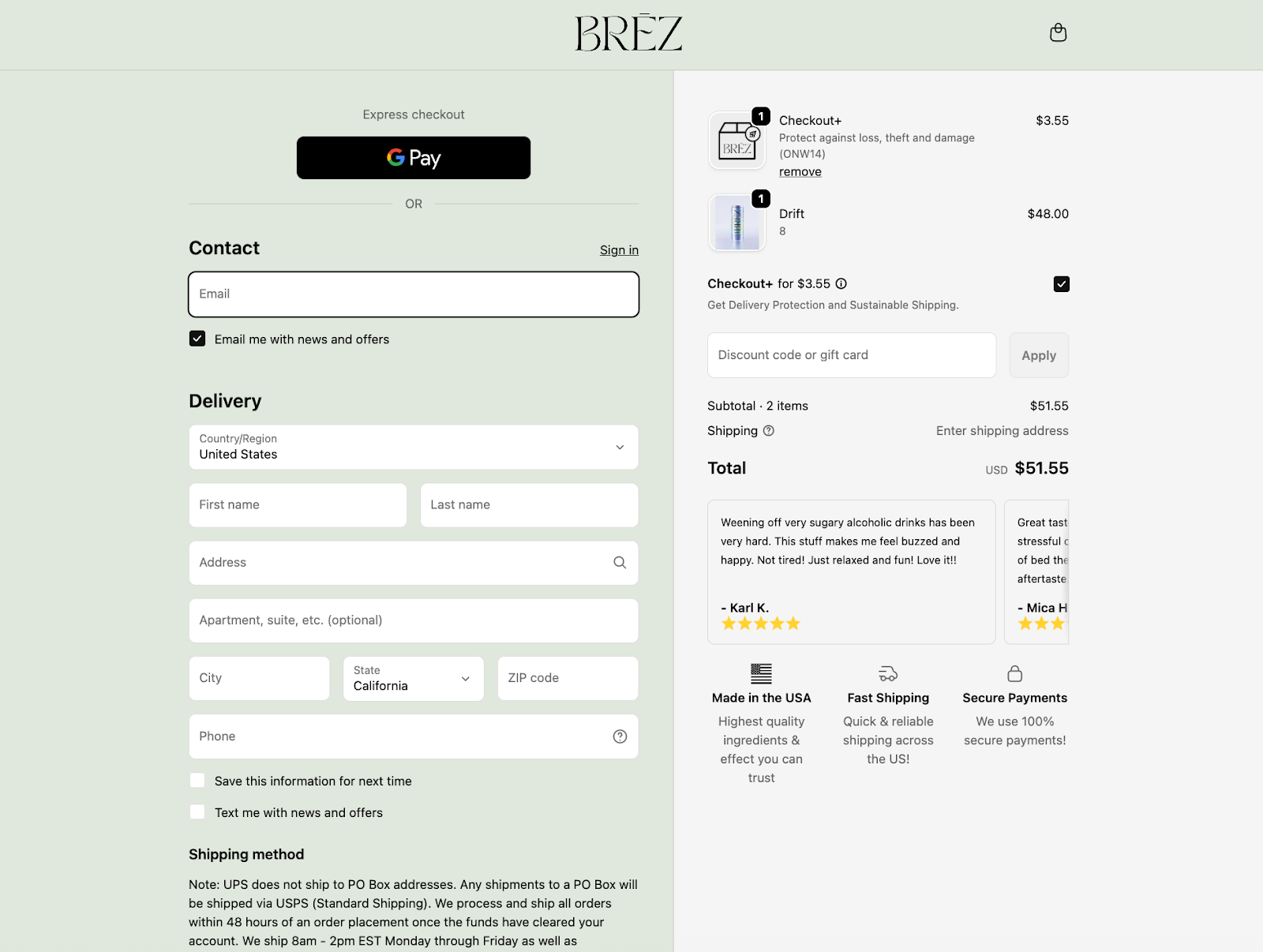
Our friends at Brez have found the perfect combination of cart layout flavours. They combine testimonials, rewards, images, and upsells to drive conversions without ever interrupting the customer experience.
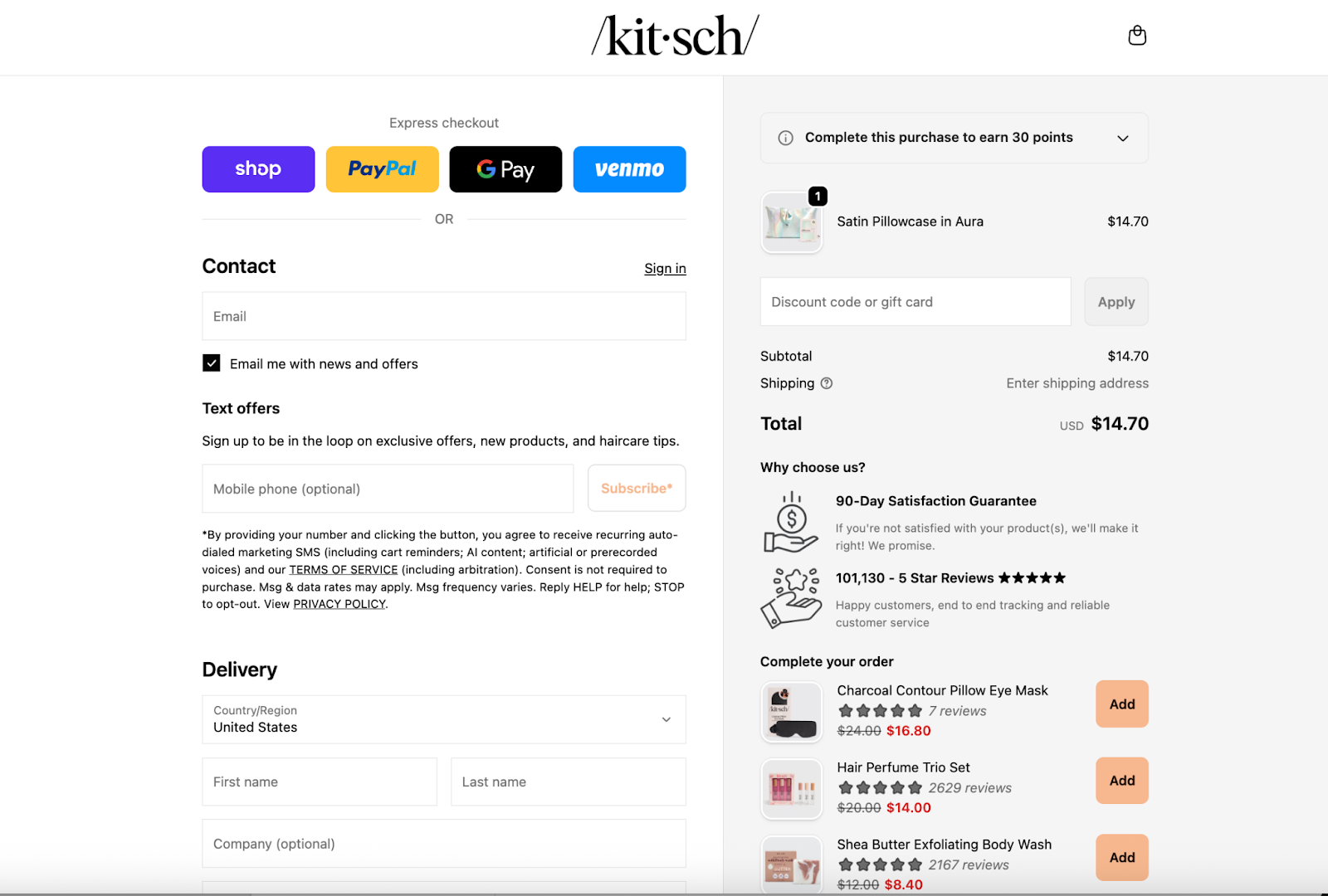
Haircare accessory brand Kitsch uses a different strategy, helping its customers build their beauty routine through an expertly crafted checkout process. Their layout integrates elements of their loyalty program, trust badges, customer reviews, and cross-sell offers directly at checkout.
For checkout optimization, as with the other tactics we’ve explored, focus on small changes that improve conversions over time. If you need a benchmark to measure up against, we’ve found that the average checkout conversion rate is 55.48%, while the average Shopify checkout conversion rate is 45%.
At checkout, the finish line is already in sight. Focus on helping customers cross it smoothly, retaining conversions while creating opportunities for incremental revenue in the process.
Thank you page optimization
If you think optimization ends when the purchase is complete, think again.
The purchase confirmation thank you page and email are the perfect places to implement add-on offers for customers.
Post-purchase confirmation emails are particularly engaging – they’re estimated to have the highest open rate of any email, with an open rate of 65%. This makes them a great strategy for zero-cost additional revenue while still providing value to your customers.
But it needs to be easy. If shoppers need to return to your site to add to their purchase, momentum will be lost, and your chance at increasing revenue will skid right off the track. Instead, let them accept post-purchase offers with one click and without needing to re-enter payment info.
Once your one-click strategy is in-place, the next step is figuring out what you should actually be upselling. This is where testing and personalization can make a big difference. With Aftersell, you can tailor and test with confidence using tags, purchase history, shipping methods, and more to dynamically target what products should be displayed. Over time, run tests to uncover which combination of products, discounts, and layouts drives the most revenue.
Here are some additional strategies worth exploring during this stage:
- Capitalize on upselling high-value and premium products to maximize your usage of this space and increase revenue
- Provide a sense of urgency using countdown clocks and eye-catching buttons that indicate a limited-time offer
- Use Rokt Thanks to drive additional revenue through adding dynamic native ads at checkout. This is a cost-per-click model that generates extra revenue for brands and only uses premium websites exclusive to Aftersell’s network.
Want to see these strategies in action?
While Moonbrew is focused on helping their customers sleep, their revenue strategy is anything but tired.
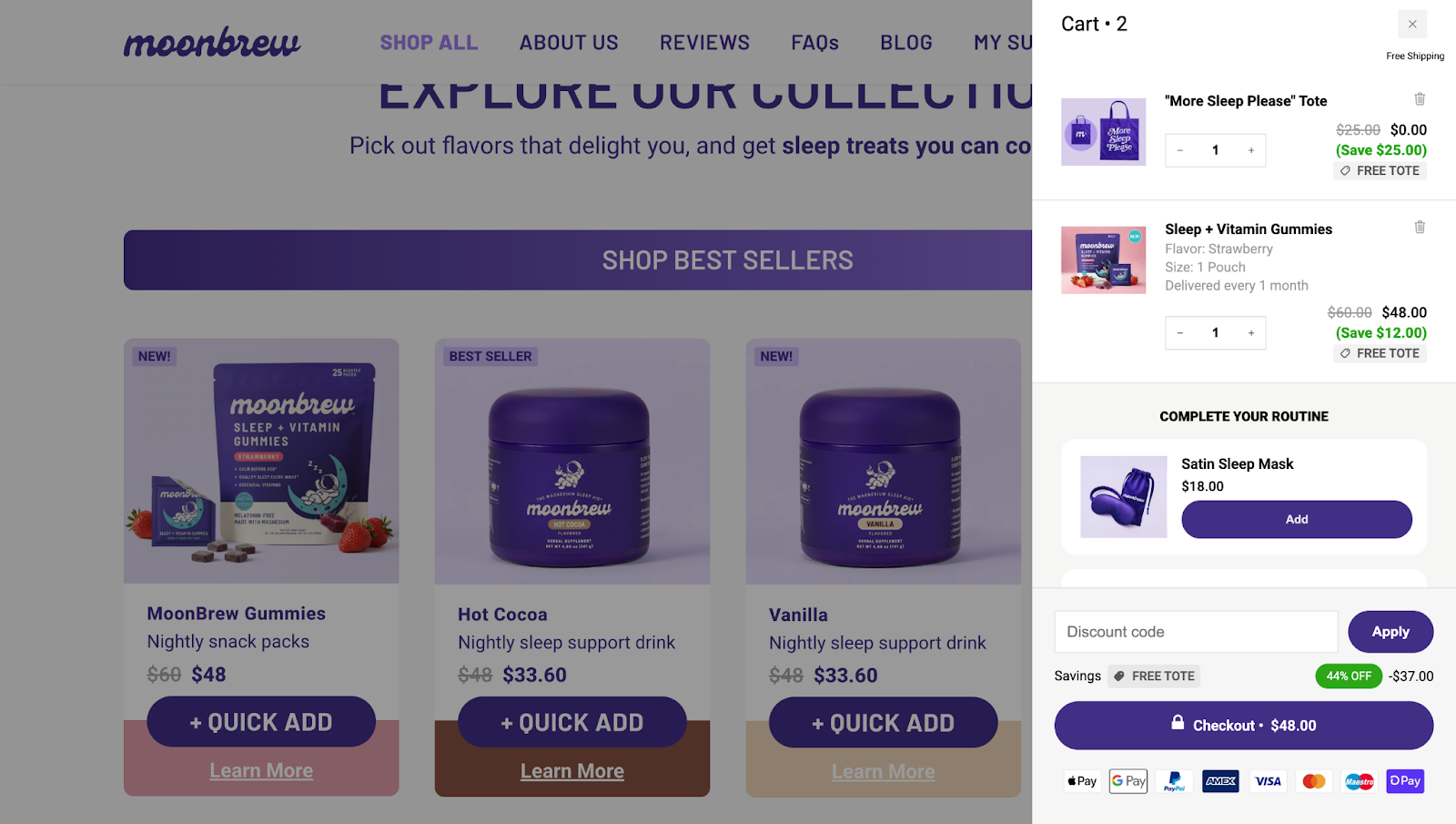
Working with Aftersell, they built in-app customization for their slide-out cart, powered by Upcart. We built machine learning-powered product recommendations, an announcement banner with a timer and a discount, and integrated shipping insurance. The result? Their post-purchase revenue increased by 100%.
Make changes today to increase revenue
If your revenue tank feels like it’s running dry, you’re not alone.
Don’t wait to make big changes. Test and analyze which variables are actually driving conversions, and watch your incremental revenue grow. Over time, continue layering in more of these strategies, and eventually you’ll have a finely tuned machine.
If you want to discuss strategy specifically for your brand, or an in-depth look at how Aftersell can help you achieve it, book a demo with us today.
Recommended Reading
.jpg)