Not to make you feel old, but 2006 was 20 years ago.
Back then, we were making our first Facebook accounts to post status updates about seeing Borat in theatres before having friends over to play Wii Sports. Simpler times.
2006 was also the year Shopify launched, changing the course of ecommerce forever. But a lot has changed since 2006.
With rising customer acquisition costs (CAC increased by 40% between 2023 and 2025), lower AOVs, and lower web traffic – combined with external challenges like economic downturns and shifting market conditions – scaling in ecommerce today is tougher than ever, with no signs of slowing down.
Brands have found the revenue optimization strategies that actually move the needle in 2026 and are increasing revenue growth without increasing CAC.
Let’s explore what’s working, what isn’t, and how you can modernize your Shopify brand.
Where Shopify brands are leaving money on the table
You can have too much of a good thing: most Shopify brands over-invest in acquisition and focus too heavily on homepage CRO.
Whether it’s optimizing headlines and CTAs, tweaking branding, or pouring more budget into paid marketing campaigns, brands are doubling down in hopes of driving more conversions and revenue.
The solution? Spread the love to under-invested parts of the customer journey like checkout, post-purchase, and retention. These stages are often overlooked and treated as an afterthought. As a result, money is being left on the table.
If you don’t focus on this part of the journey, you’re missing a major opportunity to convert and increase revenue without needing to increase traffic.
As we mentioned above, the brands winning in 2026 aren’t just driving more visitors. They’re pulling the right revenue strategy levers at exactly the right moments – powered by better data analysis, customer data, and data-driven decision-making.
The role of data in modern revenue optimization
Modern revenue optimization is powered by real-time data, automation, and better decision-making.
Leading ecommerce brands rely on:
- Real-time analytics and sales data to track performance
- Customer behavior insights to understand intent
- Segmentation and market segmentation to personalize experiences
- Demand forecasting and inventory management to align supply with customer demand
This shift toward automation and real-time insights allows brands to make informed decisions faster, improve profitability, and build more sustainable growth models.
With that in mind, here are the five levers being used to optimize revenue.
First lever moving the needle: post-purchase upsells
A common misconception is that once a transaction happens, the customer journey is over.
This obviously isn’t true, but it’s exactly why post-purchase touchpoints remain consistently underutilized. The truth? Post-purchase upsells, especially personalized ones, are a high ROI opportunity that can drive 10 to 30% of total revenue.
There are a few high-engagement areas where upsell and cross-sell placements are especially effective: product pages, the cart, at checkout, and purchase confirmation/thank you pages.
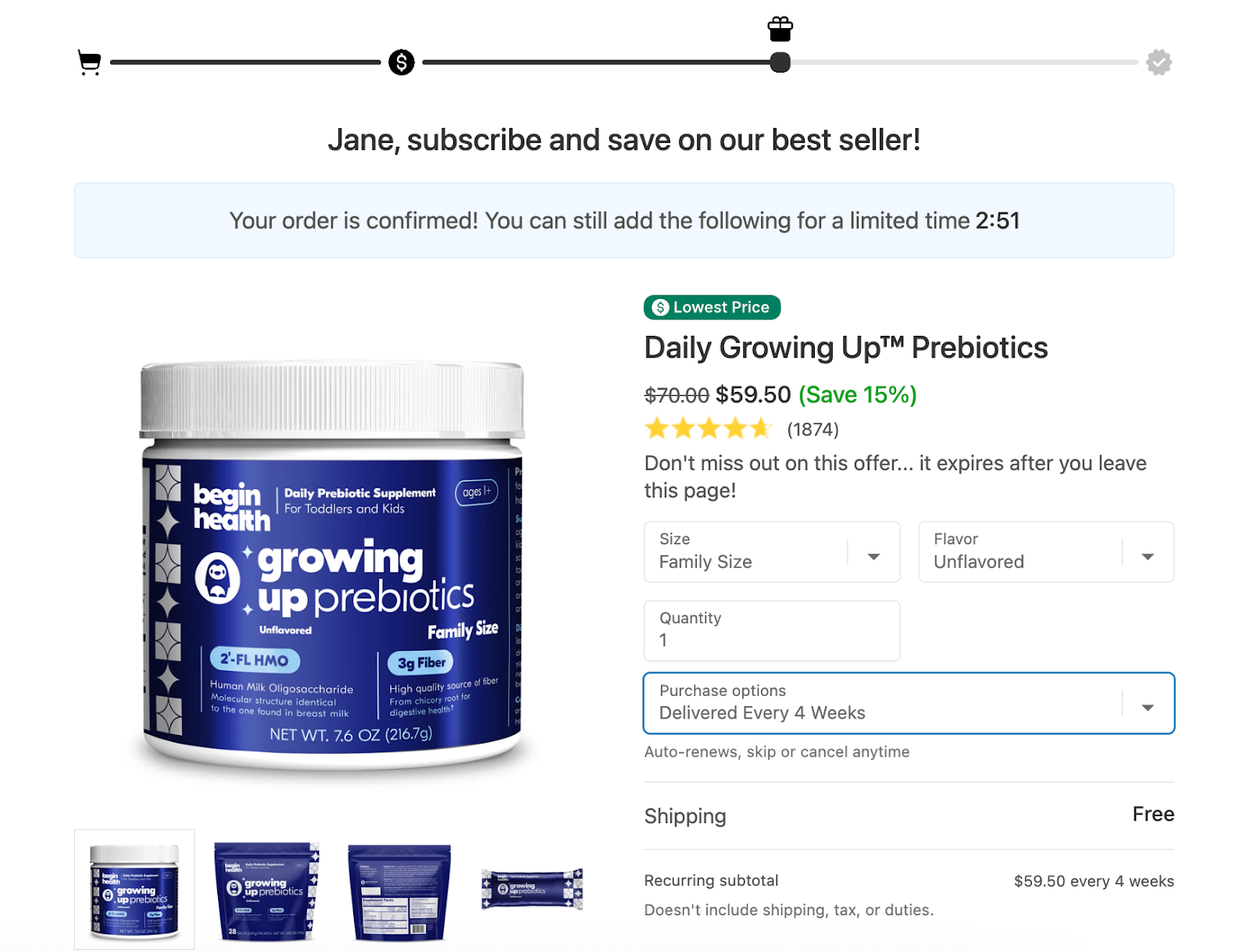
One of the biggest advantages of post-purchase upsells is that most friction points are removed because the customer has already entered their payment information. This means there’s no need to worry about disrupting a conversion by forcing entry (or re-entry) of information.
By leveraging upselling and cross-selling strategies informed by customer segments, brands can present the right offer at the right time and maximize conversion rates and customer experiences.
Cart upsells and recommendations
Not all upselling has to be done post-purchase either: product recommendations are a great way to drive incremental revenue.
By providing relevant upsell offers presented to customers in their cart or at checkout, some brands have been able to increase revenue by up to 20x.
Aftersell recommends combining add-ons, recommendations, and upsells to drive 2x higher RPV versus a single upsell.
Take, for example, Grüns.
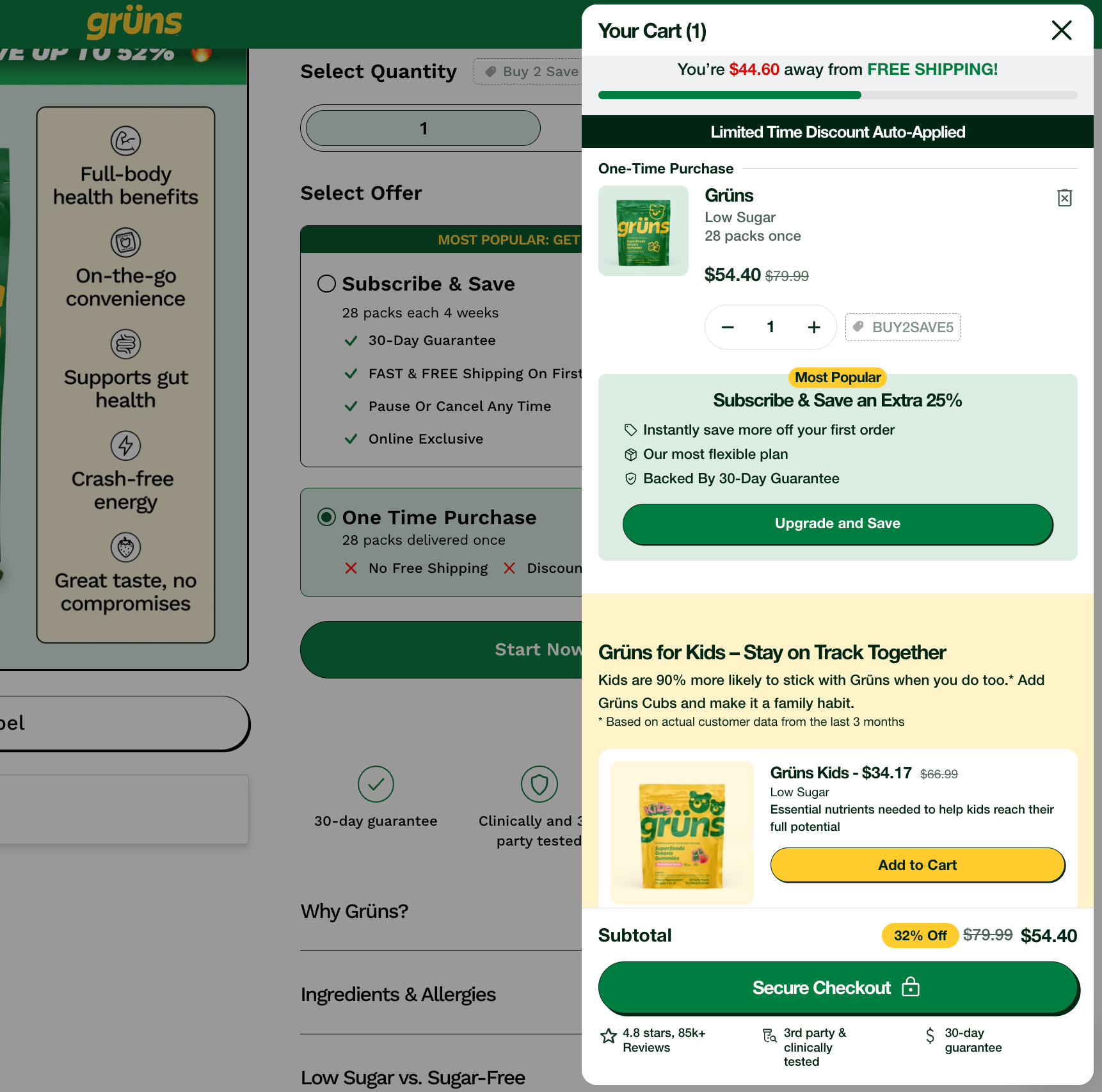
Grüns sells superfood gummies, and they’re super at post-purchase upsells too.
By using post-purchase upsells, Grüns focuses on moving customers from a shorter subscription cadence to a longer one, effectively locking in more supply and more longevity.
As a result, a meaningful number of subscribers are upgrading from a 4-week plan to a quarterly subscription after completing their purchase. More incremental revenue for Grüns and better health for their customers – it’s a win/win!
Monetizing the thank you page
The thank you page can be so much more than a receipt or proof-of-purchase.
Most Shopify brands leave it underutilized, but it can actually be monetized (hey, that rhymes).
The thank you page is a high-intent area that customers return to for confirming order details and checking shipping and tracking information, so optimizing it for conversions is the logical next step. It’s one of the few places where you have a customer’s full attention and confirmed intent, so you’ll want to make the most of it.
So how do you monetize it? It’s simple. There are two streams to consider:
- Stream 1 - First-party upsell offers: Product recommendations and cross-sells shown after order confirmation. Revenue goes directly to you. Works best for complementary products, refills, accessories, and loyalty offers.
- Stream 2 - Rokt Thanks offers: Premium offers from 1,000+ vetted national brands that are matched to each customer automatically via AI. You earn per transaction. Zero ongoing management once live.
Here’s an example with Moonbrew, where there’s an offer for 40% off an Adidas order:
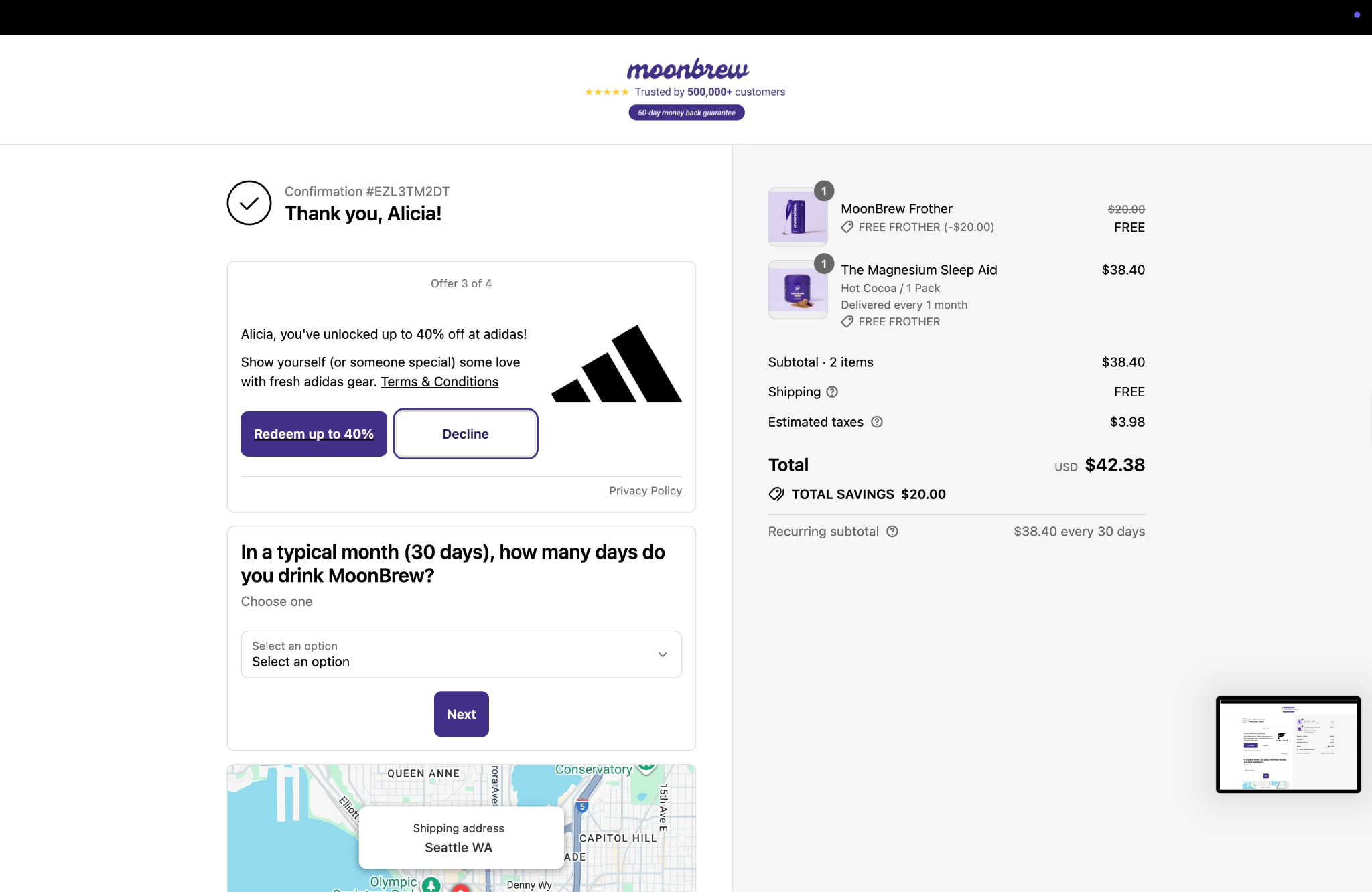
Instead of treating the thank you page as the end of a relationship, treat it as the beginning of one.
This is also a prime opportunity to collect post-purchase customer feedback, improve onboarding, and strengthen customer relationships—all of which contribute to long-term customer retention and reduced churn.
Personalization and smart targeting
93% of ecommerce shoppers will continue shopping with a brand that offers personalized experiences. There’s a reason Starbucks writes your name on your cup!
With this in mind, it only makes sense that personalization and smart targeting are core revenue optimization levers.
Today’s customers expect recommendations and offers that reflect what they’re browsing and what they’ve purchased before.
You can use personalization to increase conversions based on:
- What’s in a customer’s cart
- Their purchase history
- Their order value
- The traffic source that brought them to your site
As Michael Scott once said, “You miss 100% of the shots you don’t take - Wayne Gretzky”. The worst-case scenario is that a customer isn’t interested. But when executed effectively, personalization turns an offer from intrusive to helpful. Focus on upselling high-value or premium products, maximizing a customer’s attention and increasing incremental revenue.
With Aftersell, you can tailor and test personalized upsells to see what works best. Try using tags, purchase history, shipping methods, and more to dynamically target customers. Then, run multivariate tests across products, discounts, and layouts to uncover what drives the most revenue.
Every brand and their customer base is different. This level of segmentation and personalization enables brands to better understand customer behavior, tailor pricing decisions, and improve customer satisfaction.
A/B testing offers and customer segments
Customer tastes and ecommerce trends are always evolving, so your Shopify store should evolve too.
A/B testing is another lever moving the needle, turning good strategies into high-performing ones. By continuously refining your offers, upsell and cross-sell combinations, messaging, and more, you can uncover what actually drives revenue for your brand and customer base.
Revenue optimization is a constant work in progress, and even the smallest improvements can mean the difference between whether or not someone converts.
Here’s what we recommend A/B testing:
- The offers provided to customers
- Messaging and urgency
- Upselling single items vs bundles
- Offer timing
- Cart and post-purchase upsells
While there’s no one-size-fits-all strategy and what works best will vary by brand, the foundation remains the same: successful brands are the ones that test, learn, and iterate.
Over time, the data you gather will help you continuously refine a revenue optimization strategy that’s unique to you.
Here’s an example from HexClad:
This hybrid cookware is meant to be the last cookware you’ll ever buy, so it’s understandable that they want to drive conversions on the thank you page – their products might be too good for customers to come back!
Using logic to determine which products made the most sense as add-ons, they implemented A/B testing to try out different post-purchase offers on their thank you pages. Over time, they refined and adjusted, eventually narrowing down to 27 active, live offers running consistently across their post-purchase flows.
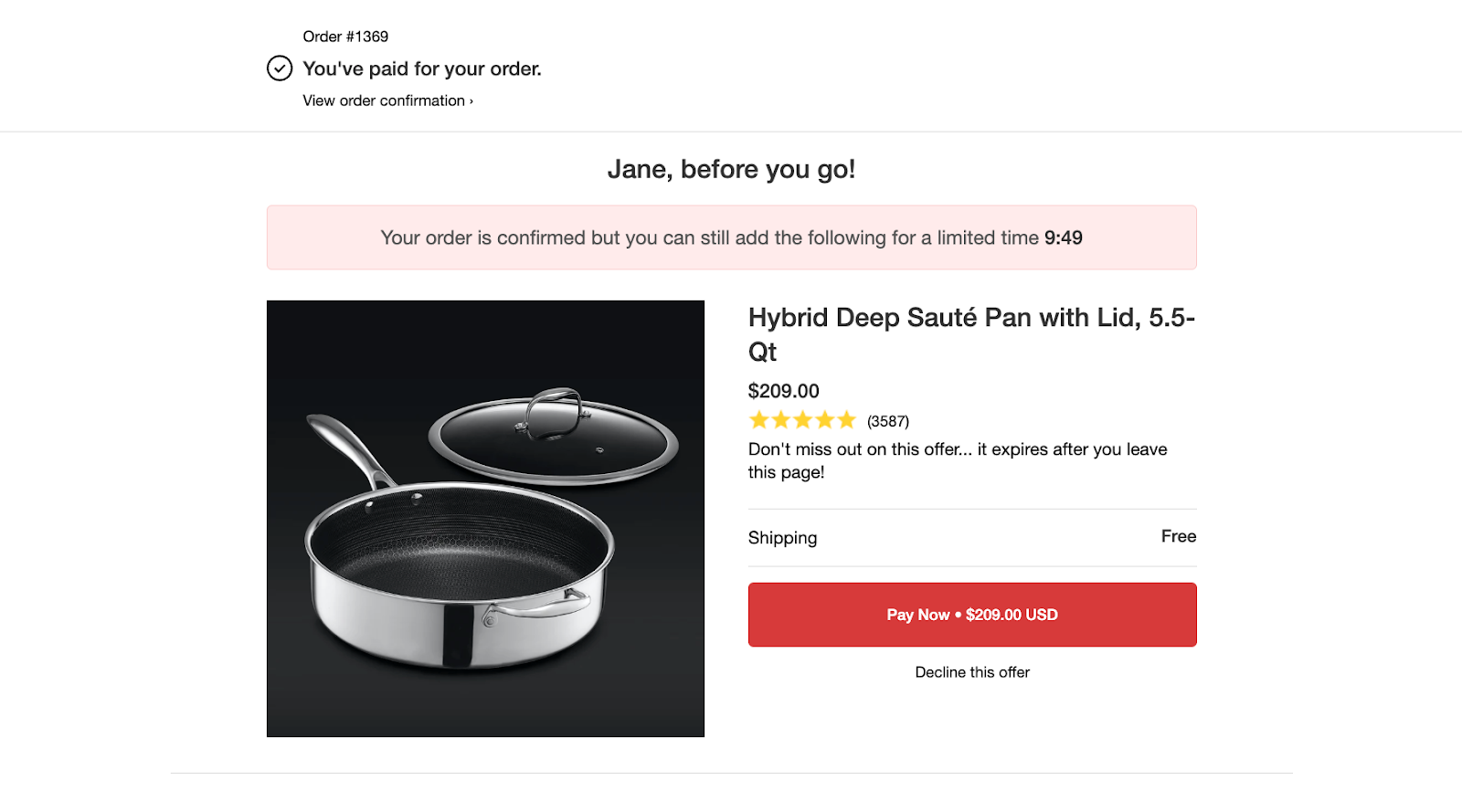
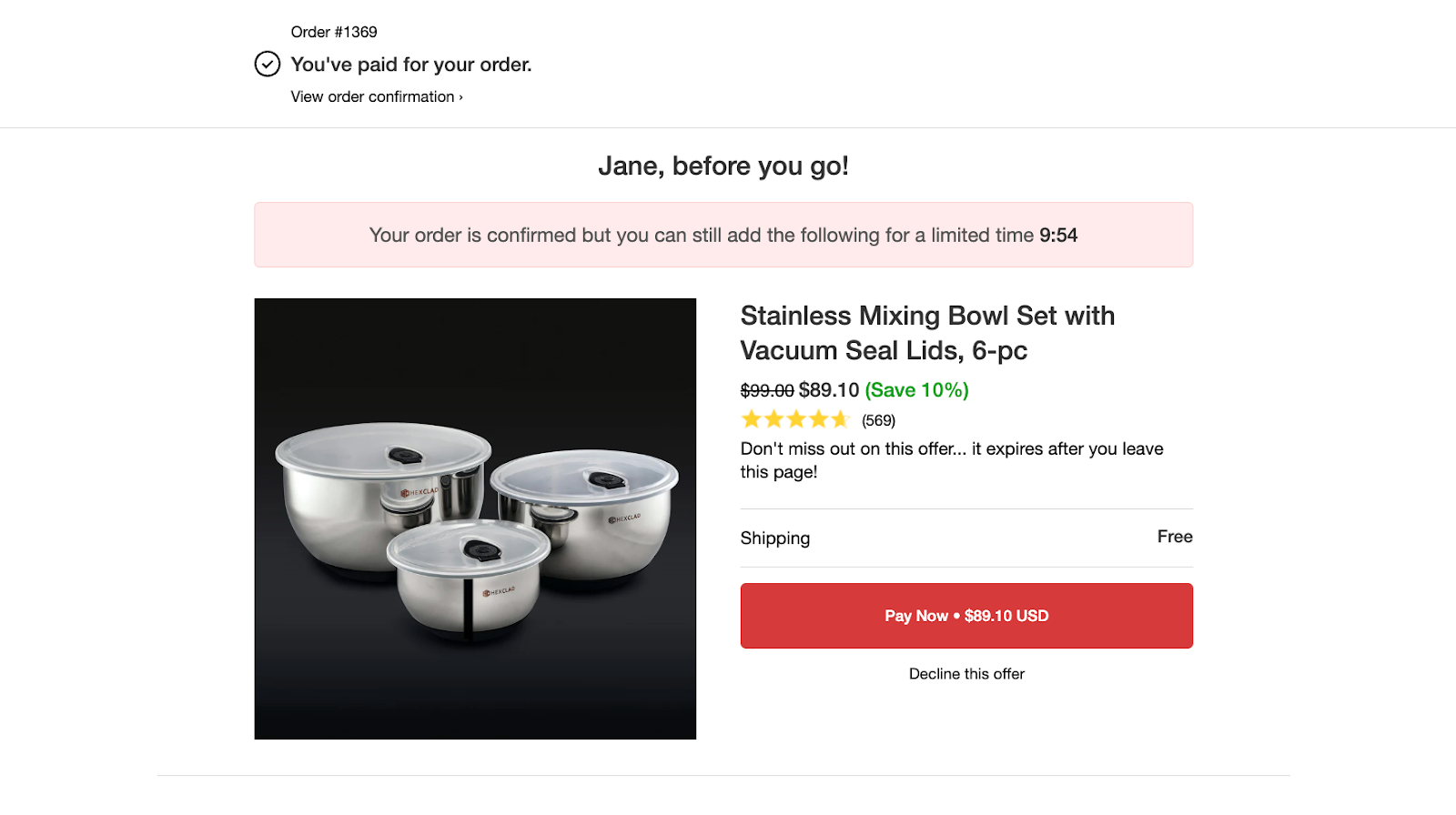
The results burned brighter than the flame under one of their woks: $2.4M in incremental post-purchase revenue and $4.91 in additional revenue per transaction.
Increasing your customer’s AOV
Remember New Coke? Coca-Cola learned the hard way what happens when you mess with a good thing, so we completely understand the hesitation brands feel about messing with the conversion stage of the funnel.
Instead of making changes to high-intent touchpoints, many ecommerce teams focus on optimizing homepages and landing pages to avoid introducing friction. But it’s okay to be a little brave!
Through intelligent optimization via personalized upsells, smart nudges, and a focus on simplicity, you can increase AOV without disrupting checkout. And with an average cart abandonment rate of around 70%, it’s definitely something worth focusing on.
To move the needle and increase AOV, focus on simplicity and relevance. Keep offers clear and relevant, remove all friction points, and prioritize post-purchase moments where customers have already committed to buying.
In fact, many of the AOV optimization solutions we recommend tie into what we’ve already explored:
- AI-powered personalized upsells: to ensure relevancy
- In-cart recommendations: to highlight complementary products
- Smart nudges: for showing a shopper just how close they are to free shipping or that next reward
- Checkout and post-purchase offers: for seamless impulse buys
A strong AOV optimization strategy can make smart upsells feel less sales-y and more like a natural extension of a shopper’s purchase.
Building a modern Shopify brand
At the end of the day, it’s all about balance.
If you want to build a successful Shopify brand, you need to focus on all parts of the customer journey – not just the “classics”.
Areas like the post-purchase phase and the checkout page have historically been underutilized, but now they’re among the strongest revenue optimization levers. Focusing on these areas can help reduce CAC by shifting attention toward nurturing existing, proven customers.
The Shopify brands winning in 2026 aren’t the ones funneling the most money into advertising – that golden Wii Sports-fueled era of 2006 is long behind us. Instead, they’re the ones optimizing each stage of the customer journey in ways that fit their audience.
If you want to optimize revenue and unlock more value from your existing customers, we can help. Book a demo today and start moving the needle.
Recommended Reading
.jpg)